
title: "Foot Valve vs Check Valve: Differences, Placement, and Selection"
Install a foot valve at the bottom of a suction pipe and it holds prime when the pump stops. Install a discharge check valve beside the pump outlet and it prevents reverse flow from the system. Both block backflow, but the foot valve combines strainer and retention functions at the inlet where debris enters and where losing prime means the pump runs dry. The discharge check valve sits where system pressure is highest and where access for inspection is simplest. Choose based on whether you need to retain suction-side fluid, whether solids must be filtered before entering the pump, and whether the installation allows bottom-of-pipe access for cleaning.
This guide explains construction differences, placement rules, head-loss and maintenance tradeoffs, and when both valves are required in the same system.
الوجبات الرئيسية
- A foot valve is a check valve with an integral strainer designed for installation at the suction inlet, typically submerged or at the lowest point of a suction lift system.
- Foot valves retain prime in non-self-priming pumps by preventing suction-line drainage; discharge check valves prevent reverse rotation and system backflow but do not hold prime.
- Foot valves add measurable head loss depending on strainer area, debris loading, and valve size; discharge check valves contribute additional loss when undersized or when debris passes through the pump.
- Inspection and cleaning of a foot valve require draining and accessing the bottom of the suction pipe; discharge check valves can usually be serviced without entering confined spaces.
- Many installations require both: a foot valve to hold prime and a discharge check valve to protect against water hammer and parallel-pump reverse flow.
A Foot Valve Is a Check Valve Built for the Suction Inlet
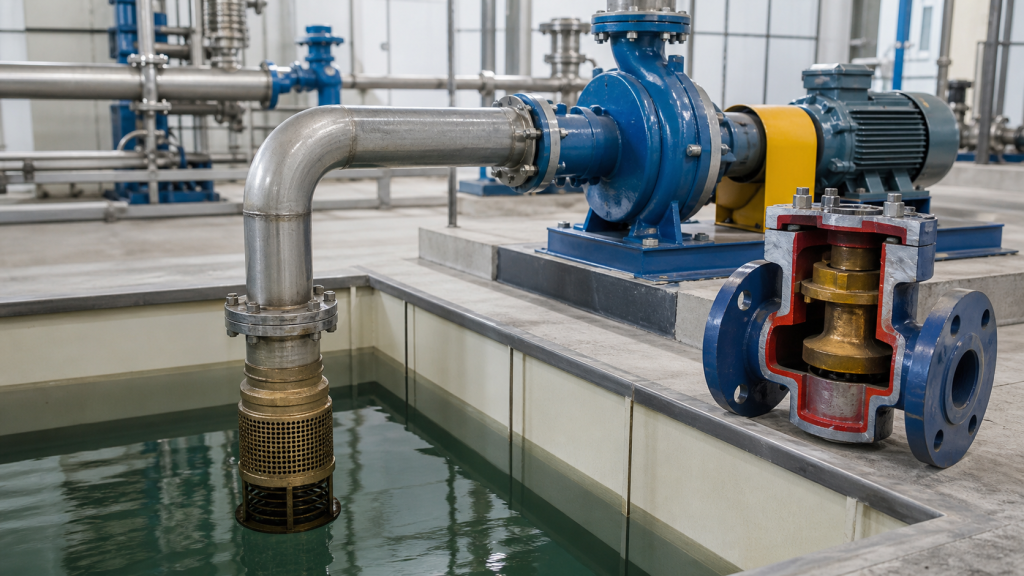
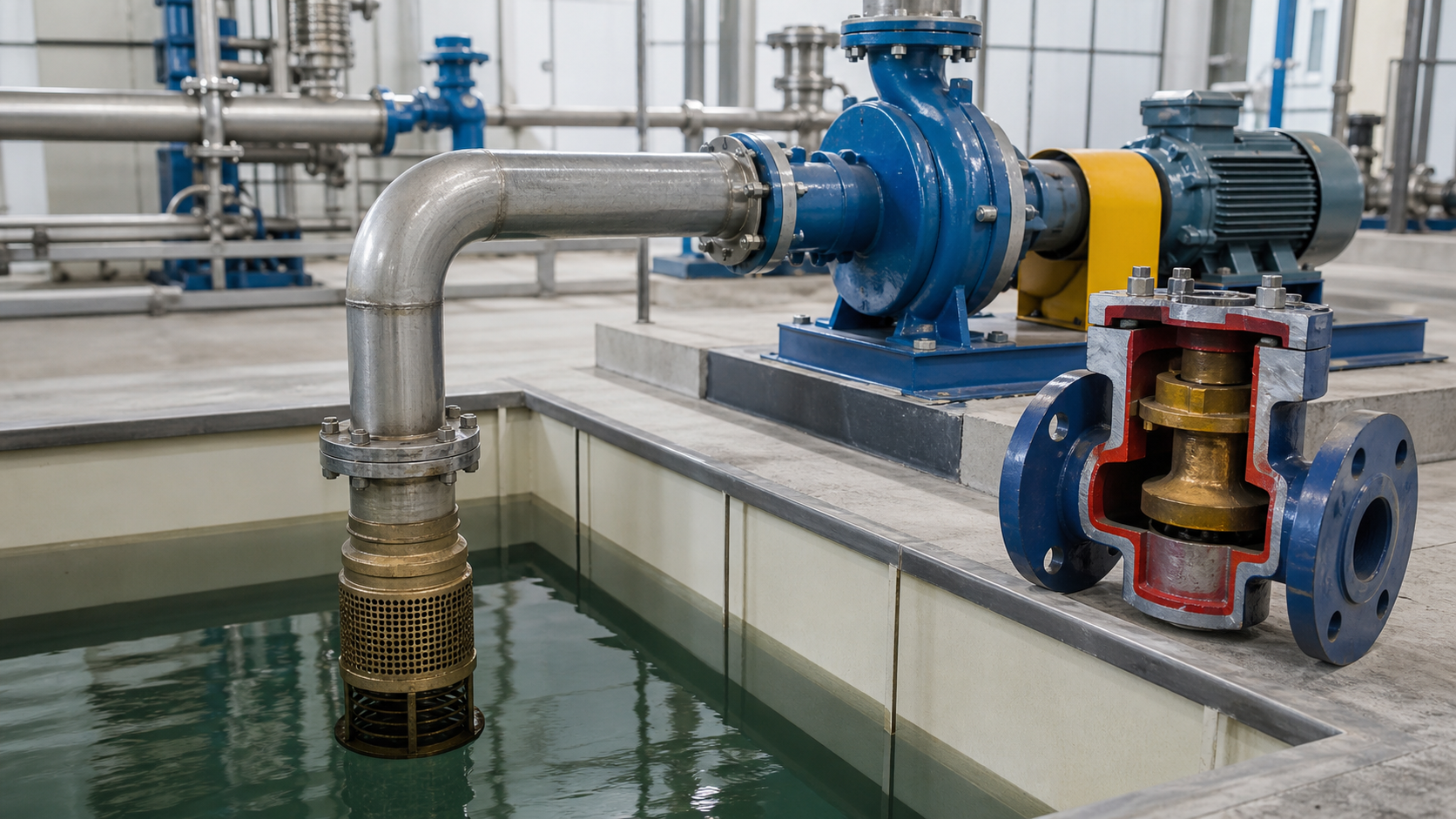
A foot valve is not an alternative to a discharge check valve; it is a specialized check valve designed to sit at the suction inlet where three functions converge. First, it prevents backflow so the suction pipe remains full when the pump stops, eliminating the need to re-prime. Second, the integral strainer excludes debris that would damage the impeller or clog wear rings. Third, it anchors the suction pipe and resists movement during startup transients.
A standard discharge check valve mounts in the discharge line near the pump and serves a different purpose: it isolates the pump from system pressure when flow stops, preventing reverse rotation, water hammer, and backflow through idle pumps in multi-pump systems. It has no strainer because the pump itself has already filtered large solids by the time fluid reaches the discharge.
Understanding the fundamental difference between foot valves and check valves clarifies why installation location drives the design. The foot valve must tolerate submersion, handle raw intake water, and resist clogging while maintaining a seal against low suction pressure. The discharge check valve must close quickly against high system pressure, absorb hydraulic transients, and allow frequent inspection.
Construction, Strainer, and Flow Direction
Foot valves use a basket or perforated screen around the inlet with openings sized to block solids larger than the pump’s minimum passage diameter. Common strainer materials include bronze, stainless steel, and reinforced thermoplastic. The check element is typically a poppet, swing disc, or ball that lifts during flow and seats under gravity and backpressure when flow stops. The body must seal reliably at low differential pressures because any leakage allows the suction line to drain and the pump to lose prime.
Discharge check valves omit the strainer and optimize for higher pressure drops and faster closure. Swing check valves, lift check valves, dual-plate wafer checks, and silent check valves each trade closure speed, head loss, and water-hammer resistance. Materials range from cast iron and ductile iron for municipal water to bronze and stainless steel for corrosive or high-temperature services.
Flow direction is non-negotiable for both valve types. Foot valves install with flow upward through the strainer into the suction pipe. Discharge check valves install with flow from the pump toward the system, and the body arrow must align with flow direction. Reversed installation either prevents flow entirely or allows unrestricted backflow.
Priming Retention versus Reverse-Flow Prevention
Priming retention is the foot valve’s primary function. In a suction-lift application—where the pump sits above the water source—the suction line must remain full of liquid for the pump to develop suction. Centrifugal pumps cannot evacuate air; if the suction line drains, the pump runs dry and overheats. A foot valve at the inlet holds the column of water in the suction pipe so the pump starts against liquid, not air.
Discharge check valves do not retain prime because they sit downstream of the pump where the pipe is under pressure during operation and where drainage back through the pump during shutdown does not affect priming. Their role is to prevent backflow that would reverse the impeller, cause water hammer when the reverse flow suddenly stops, or allow one pump to feed another in parallel installations.
The priming distinction determines valve selection. If the pump is self-priming or operates under flooded suction—where the inlet is below the source water level and gravity keeps the suction line full—a foot valve may be unnecessary for prime retention. A discharge check valve is still required to prevent backflow from the system. Conversely, if the pump relies on suction lift and is not self-priming, a foot valve is mandatory regardless of discharge piping configuration.
Suction-Lift and Flooded-Suction Placement
In suction-lift installations, place the foot valve at the lowest practical point in the suction line, typically at the submerged inlet screen or hanging just above the bottom of a well, sump, or pond. Submergence must exceed the sum of the velocity head at the inlet and the drawdown during operation to prevent vortexing and air entrainment. Consult the pump manufacturer’s installation drawing for minimum submergence at the specified flow rate and inlet diameter.
Flooded-suction installations often omit the foot valve because gravity maintains a full suction line. However, a foot valve may still be installed if the source contains debris that would damage the pump or if site procedures require positive shutoff at the inlet. In these cases, the foot valve acts as a combined strainer and isolation point rather than a priming device.
Discharge check valve placement follows different rules. Install the valve in a horizontal or vertical-upward section of the discharge line, as close to the pump as practical but after any isolation valves and pressure gauges. Avoid installing swing check valves in vertical-downward flow, where gravity opposes disc closure and allows prolonged backflow. For vertical-downward applications, use a spring-assisted check valve or a dual-plate wafer design that closes under spring force rather than gravity alone.
Head Loss, Debris, Leakage, and Water Hammer
Head loss through a foot valve depends on strainer open area, valve size, and debris accumulation. A clean foot valve adds head loss that must be accounted for in the system curve and NPSHa calculation. As debris clogs the strainer, head loss increases and pump performance degrades. Excessive head loss reduces net positive suction head available (NPSHa) and can induce cavitation if NPSHa falls below the pump’s required NPSHr.
To estimate head loss from valve data, use the valve’s Cv (flow coefficient) and the required flow rate. For a hypothetical example with Cv = 150 and a flow rate of 100 GPM:
ΔP (psi) = (Q / Cv)²
where Q is flow in GPM and Cv is the valve’s flow coefficient.
ΔP = (100 / 150)² = 0.44 psi, or approximately 1 foot of head.
Debris loading can multiply this value before cleaning is required. Monitor suction pressure or inlet vacuum to detect clogging before cavitation occurs. The manufacturer’s performance curve or test data provides the Cv for a specific valve model and size.
Discharge check valves add head loss that increases with undersizing or debris passage. Undersized check valves create excessive head loss and may chatter or fail to open fully. Oversized check valves close slowly, allowing reverse flow and water hammer. Water hammer occurs when a column of moving water suddenly stops—such as when a pump trips and the discharge check valve slams shut. The pressure spike can exceed the system’s rated pressure and damage piping, fittings, and the pump casing.
Leakage through either valve type defeats its purpose. A leaking foot valve drains the suction line overnight, requiring repriming before each start. A leaking discharge check valve allows continuous backflow, wasting energy and potentially reversing the pump. Inspect valve seats and seals during maintenance and replace worn components before leakage becomes chronic.
Inspection and Access Tradeoffs
Foot valve inspection requires draining the suction line and physically accessing the valve at the bottom of the pipe—often in a well, sump, or submerged intake. This means confined-space entry, dewatering, or lifting equipment to retrieve the valve. Maintenance intervals depend on water quality: clean well water may allow annual inspection, while surface water with high sediment loads may require more frequent strainer cleaning.
Discharge check valve inspection is simpler. The valve sits near the pump, usually above ground and accessible from a walkway or equipment pad. Many systems include a downstream isolation valve and a drain connection to allow check valve removal without draining the entire system. Inspection frequency depends on system cycling, water quality, and valve type.
The access tradeoff shapes long-term costs. Foot valves have lower initial cost than self-priming pumps but higher maintenance labor. Discharge check valves have moderate initial cost and low maintenance cost but do not eliminate the need for a foot valve in suction-lift applications.
When a Discharge Check Valve Is Still Needed
Installing a foot valve does not eliminate the need for a discharge check valve. The foot valve prevents suction-line drainage; the discharge check valve prevents reverse flow from the system. Both functions are often required.
Consider a well pump feeding an elevated storage tank. The foot valve holds prime in the suction line. When the pump stops, system pressure from the elevated tank drives water back toward the pump. Without a discharge check valve, this backflow reverses the impeller, causing wear and potential seal damage. The discharge check valve blocks this reverse flow while the foot valve maintains prime for the next start cycle.
In multi-pump installations, a discharge check valve on each pump prevents a running pump from feeding back through an idle pump. Even if all pumps have foot valves, the discharge check valves are still required to isolate each pump’s discharge and prevent cross-flow.
In systems with significant static head or long discharge piping, the discharge check valve also limits water hammer. When the pump stops, the moving column of water in the discharge line decelerates. Proper check valve selection and placement ensure the valve closes before reverse flow accelerates, minimizing the pressure spike.
Selection Table by Installation
Installation Type | Foot Valve Required | Discharge Check Required | ملاحظات |
|---|---|---|---|
Suction lift, non-self-priming pump | نعم | نعم | Foot valve retains prime; discharge check prevents backflow and reverse rotation |
Flooded suction, clean source | لا | نعم | Gravity maintains prime; discharge check isolates pump from system pressure |
Flooded suction, debris-laden source | اختياري | نعم | Foot valve acts as inlet strainer; discharge check still required for backflow prevention |
Self-priming pump, suction lift | لا | نعم | Pump re-primes automatically; discharge check prevents reverse rotation |
Well pump to elevated tank | نعم | نعم | Foot valve maintains prime; discharge check prevents backflow from tank |
Multi-pump parallel system | Depends on suction | Yes (each pump) | Discharge checks prevent cross-flow between pumps |
Sump or dewatering pump | اختياري | نعم | Foot valve reduces repriming frequency; discharge check prevents drain-back |
الأسئلة الشائعة
Can a discharge check valve be installed at the suction inlet instead of a foot valve?
No. A standard discharge check valve lacks the integral strainer required to protect the pump from inlet debris. It also may not seal reliably at the low differential pressures found in suction lines. If a foot valve is unavailable, install a separate suction strainer and a low-pressure check valve rated for the suction-side pressure range, but verify that the combined head loss does not reduce NPSHa below the pump’s NPSHr.
How do I know when the foot valve strainer is clogged?
Monitor suction pressure or vacuum during operation. A rising vacuum reading or falling suction pressure at constant flow indicates increasing head loss upstream of the pump. Compare current readings to baseline values recorded when the strainer was clean. If the pump loses prime frequently despite a closed foot valve, inspect the valve seat for leakage rather than assuming the strainer is clogged.
Why does my discharge check valve slam shut and cause water hammer?
Slamming occurs when the valve closes too slowly, allowing reverse flow to accelerate before closure. Oversized check valves, worn hinges, or incorrect valve types contribute to slow closure. For high-head or long-pipeline systems, replace standard swing checks with spring-assisted or dual-plate designs that close faster. Alternatively, install a slow-closing check valve with a dashpot or hydraulic damper that decelerates the disc just before seating, reducing the final impact without allowing significant reverse flow.
Can I use a foot valve in a vertical turbine or submersible pump installation?
Vertical turbine pumps typically operate under flooded suction with the pump bowl submerged below the water level, so a foot valve is usually unnecessary for prime retention. However, a foot valve or suction strainer may be installed at the intake if the source contains debris. Submersible pumps are fully submerged and do not require a foot valve for priming, but a check valve in the discharge line is still required to prevent backflow and column drain-down when the pump stops.
What happens if the foot valve leaks slightly but does not drain the suction line completely?
Slight leakage extends the time required to re-establish full prime after each start, increasing motor run time and energy consumption. It also reduces the effective NPSHa by lowering the fluid level in the suction line, which can trigger intermittent cavitation. Replace the valve or reseat the disc if leakage exceeds the pump’s repriming capacity. Even slow leakage accumulates over time and may cause the pump to lose prime during extended shutdowns.
الخاتمة
Foot valves retain prime at the suction inlet by combining check function with debris straining; discharge check valves prevent backflow and reverse rotation in the discharge line without holding prime. Most installations require both. Select foot valves based on strainer area, submergence, and access for cleaning. Select discharge check valves based on closure speed, pressure rating, and water-hammer resistance. Before finalizing the design, confirm that total suction-side head loss—including the foot valve, piping, fittings, and lift—leaves adequate NPSH margin above the pump’s NPSHr at the duty point. Measure suction pressure during commissioning and establish baseline readings so maintenance teams can detect strainer clogging or valve leakage before performance degrades.