
Selecting a vertical multistage pump for a car wash starts with one basic question: where will the pump operate in the water system?
A commercial car wash does not use one type of water at one pressure. Municipal water, stored water, filtered reclaim water and reverse-osmosis water may pass through separate circuits before reaching the vehicle. Some parts of the system need a stable supply at moderate pressure, while the cleaning nozzles may require a dedicated high-pressure plunger pump.
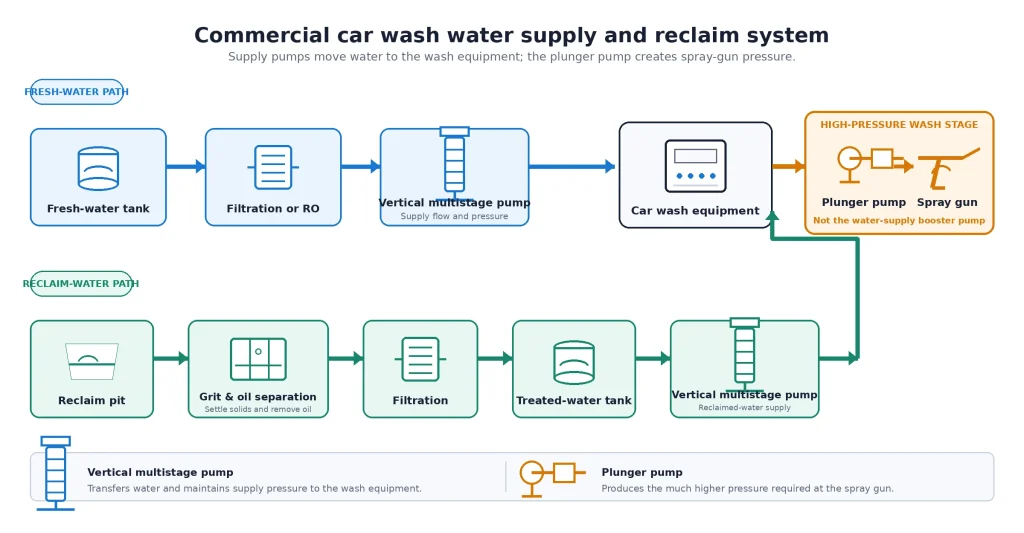
A vertical multistage centrifugal pump is normally used on the water-supply and treatment side. It can feed filtration equipment, supply an RO system, transfer appropriately treated reclaim water or maintain pressure in a clean-water distribution line.
It should not automatically be treated as a replacement for the piston or plunger pump used to produce very high pressure at the spray nozzle.
Different pump duties inside the same car wash
A typical commercial car wash may contain several pump duties.
Incoming water is often stored in a tank before being sent through filters, softeners or membrane equipment. A vertical multistage pump can draw from this clean-water tank and provide the flow and pressure required by the treatment system.
After treatment, another pump may distribute the water to the wash equipment or final-rinse circuit. If reclaimed water is used, a separate pump may transfer it after the necessary separation and filtration stages.
The high-pressure spray circuit is different. Professional wash guns and touchless nozzles often require a reciprocating piston or plunger pump. This pump is designed to produce much higher pressure at a relatively controlled flow.
The vertical multistage pump supports the upstream water system. The plunger pump produces the final nozzle pressure. In many installations, both are required.
Fresh-water supply and pressure boosting
Low or unstable incoming water pressure can affect the entire car wash process. When several wash points operate at the same time, the available inlet pressure may fall. Filters and treatment equipment may receive insufficient flow, and a downstream high-pressure pump may also experience poor inlet conditions.
A vertical multistage pump can increase the supply pressure and provide a more stable inlet condition for the next part of the system. Because its impellers are arranged in series, the pump can generate relatively high head while maintaining a compact footprint.
This makes it useful in equipment rooms where floor space is limited. The inline inlet and outlet arrangement of many CDL and CDLF pumps can also simplify the pipe layout.
However, the pump still has to be selected from its performance curve. Installing a larger motor does not automatically produce the correct pressure or flow. The system duty point must be determined first.
Feeding filtration and reverse-osmosis equipment
Reverse-osmosis water is often used for spot-free final rinsing because it contains fewer dissolved minerals. An RO system may also include sediment filters, carbon filters, softening equipment, storage tanks, instruments and control valves.
Depending on the process design, a vertical multistage pump can supply the pretreatment line or provide the pressure required at the membrane inlet.
The MISLIER CDL/CDLF range is designed for applications including clean-water supply, industrial boosting, washing systems, ultrafiltration and reverse osmosis. The correct model and number of stages depend on the membrane feed flow, required pressure and available inlet pressure.
“RO feed pump” is therefore an application description, not a complete pump specification.
The position of the pump also matters. RO feed water, RO permeate and RO concentrate can have different characteristics. The material and mechanical seal should be confirmed for the actual liquid passing through the pump.
Pumping treated reclaim water
Water reclamation can reduce fresh-water consumption, but reclaim water should not be treated as ordinary clean water without checking its condition.
According to the U.S. EPA’s guidance for vehicle washes, a basic reclaim system should at least separate grit, oil and grease. That level of treatment may be sufficient for certain undercarriage-washing duties. Additional washing stages can require oxidation, filtration, membrane filtration or deionization.
This is directly relevant to the pump.
Standard CDL/CDLF vertical multistage pumps are intended for clean, thin liquids without solid particles or fibres. They should not draw untreated water directly from a reclaim pit containing sand, sludge, oil or suspended debris.
A more suitable arrangement is to collect the wastewater, remove grit and oil, filter the water and transfer it to a treated-water tank. A vertical multistage pump may then be installed downstream if the resulting water quality is compatible with the selected hydraulic components and mechanical seal.
For reclaim-water projects, we normally ask for information about the treatment process and available water analysis before confirming the pump material.
Calculating the required flow
Daily water consumption is useful for estimating tank and treatment capacity, but it is not enough to size the pump. Pump flow should be based on the highest realistic simultaneous demand.
For example, an undercarriage circuit, a filter backwash process and an RO feed line may operate at different times. If two processes can run together, their combined flow must be considered. If the control system prevents simultaneous operation, the required pump flow may be lower.
The calculation should reflect the actual control sequence rather than adding every connected device without considering how the system operates.
This is especially important in multi-bay car washes. Selecting one oversized pump for the theoretical total demand can lead to inefficient low-flow operation during quieter periods.
Calculating the required head
The required pump head normally includes:
Total head = required outlet pressure + elevation difference + pipe losses + equipment losses
Filters, valves, fittings, treatment equipment and long pipes all create pressure losses. These losses increase as flow rises.
A filter also creates more resistance as it becomes dirty. If the pump is selected only according to the pressure drop of a new filter, system performance may fall before the filter reaches its intended cleaning or replacement point. The expected operating pressure drop should be included.
Inlet conditions are equally important. CDL/CDLF pumps are non-self-priming, so the inlet arrangement must keep the pump filled and provide sufficient available NPSH.
A low tank level, long suction pipe, undersized inlet pipe or high water temperature can reduce inlet pressure and increase the risk of cavitation. Pump selection should therefore consider both the discharge and suction sides.
For more information about motor speed and frequency, see our guide to vertical pump motor selection.
Selecting pump materials
For clean, non-corrosive water, a standard CDL configuration may be suitable. Where stainless steel wetted parts or improved corrosion resistance are required, a CDLF configuration can be considered.
However, material selection should not be based only on the words “reclaim water” or “RO water.”
Chloride concentration, detergent residue, pH, temperature and cleaning chemicals can all affect material compatibility. The pump casing is only one part of the decision. Impellers, shaft components, the mechanical seal and elastomers must also be compatible with the liquid.
For this reason, 316L stainless steel should not automatically be presented as the solution for every car wash. In some systems, 304 stainless steel may be sufficient. In others, the liquid or chemical concentration may require a more detailed review.
Single-, twin- and multi-pump systems
A duty-and-standby system keeps one pump available if the operating pump develops a fault. Alternating control distributes operating hours between the pumps instead of leaving the same unit in continuous service.
Where demand changes throughout the day, several smaller pumps can be staged according to consumption. One pump handles low demand, and another starts when more wash equipment operates. A VFD can regulate the lead pump to maintain the pressure setpoint.
MISLIER can configure double-pump, triple-pump and larger vertical pump systems with:
- Duty/standby operation
- Alternating control
- Dry-running protection
- Automatic fault changeover
- Constant-pressure control
The final configuration depends on the required flow range, pressure stability, redundancy level and local electrical supply.
When a vertical multistage pump is not suitable
A vertical multistage pump should not be connected directly to an untreated reclaim pit. Solids and abrasive material can block narrow internal passages or accelerate wear.
It may also be unsuitable when the liquid contains long fibres, large particles or a high concentration of abrasive solids. A different pump type and pretreatment arrangement may be required.
If the cleaning nozzle requires extremely high pressure, a dedicated plunger pump should be selected for that circuit. The vertical multistage pump can still supply the upstream water, but it should not be expected to perform both duties without a proper hydraulic evaluation.
Work with MISLIER on your car wash project
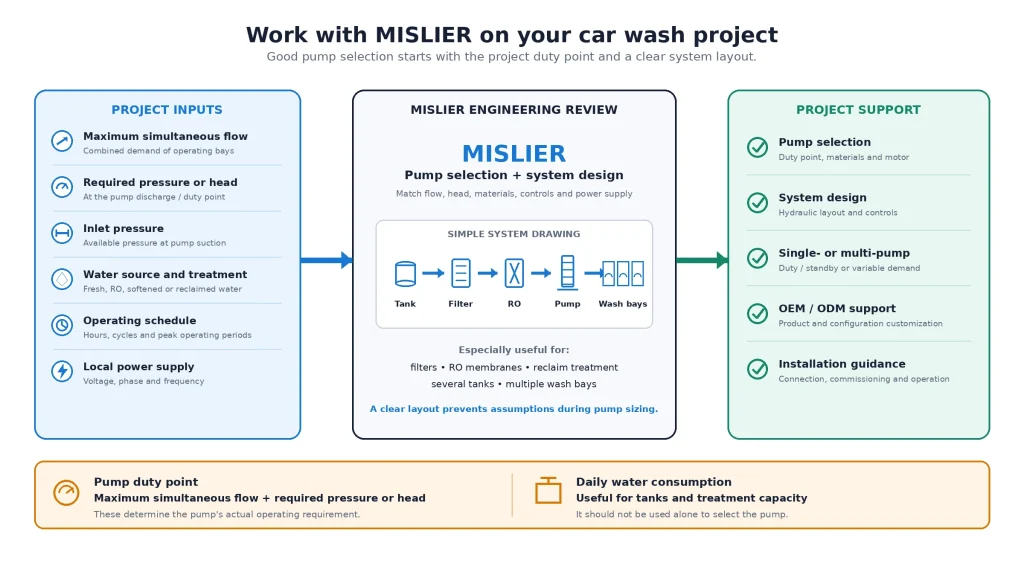
For pump selection, we normally ask for the maximum simultaneous flow rather than only the daily water consumption. We also need the required pressure or head, inlet pressure, water source, treatment process, operating schedule and local power supply.
A simple system drawing is particularly useful when the project contains filters, an RO membrane, reclaim-water treatment, several tanks or multiple wash bays.
MISLIER can provide pump selection, system design, single- or multi-pump configurations, OEM/ODM support and installation guidance.
الأسئلة المتداولة
Can a vertical multistage pump directly power a high-pressure car wash gun?
It depends on the required pressure, but professional high-pressure spray circuits commonly use piston or plunger pumps. A vertical multistage centrifugal pump is more often used for water supply, filtration, RO feed, treated-water transfer or upstream pressure boosting.
Is one pump enough for a commercial car wash?
A single pump may be sufficient for a small system. Sites that require variable capacity or operational redundancy may use two or three pumps with alternating operation, duty/standby control and automatic fault changeover.
What information does MISLIER need for selection?
Please provide the required flow, required pressure or head, inlet pressure, water source, water quality, liquid temperature, operating schedule, voltage, phase and frequency.