
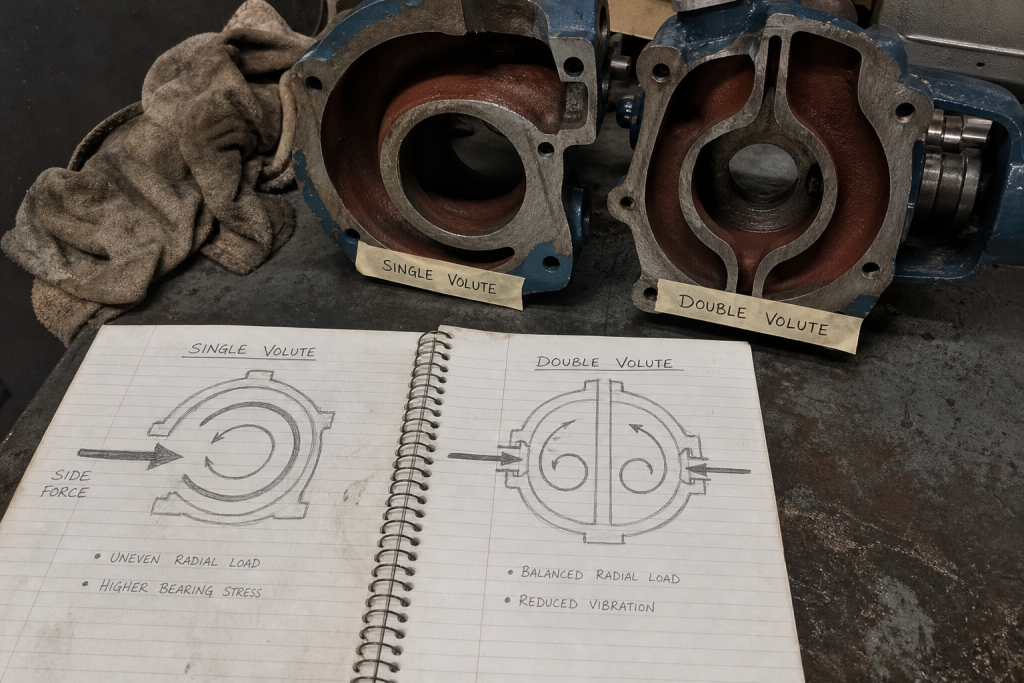
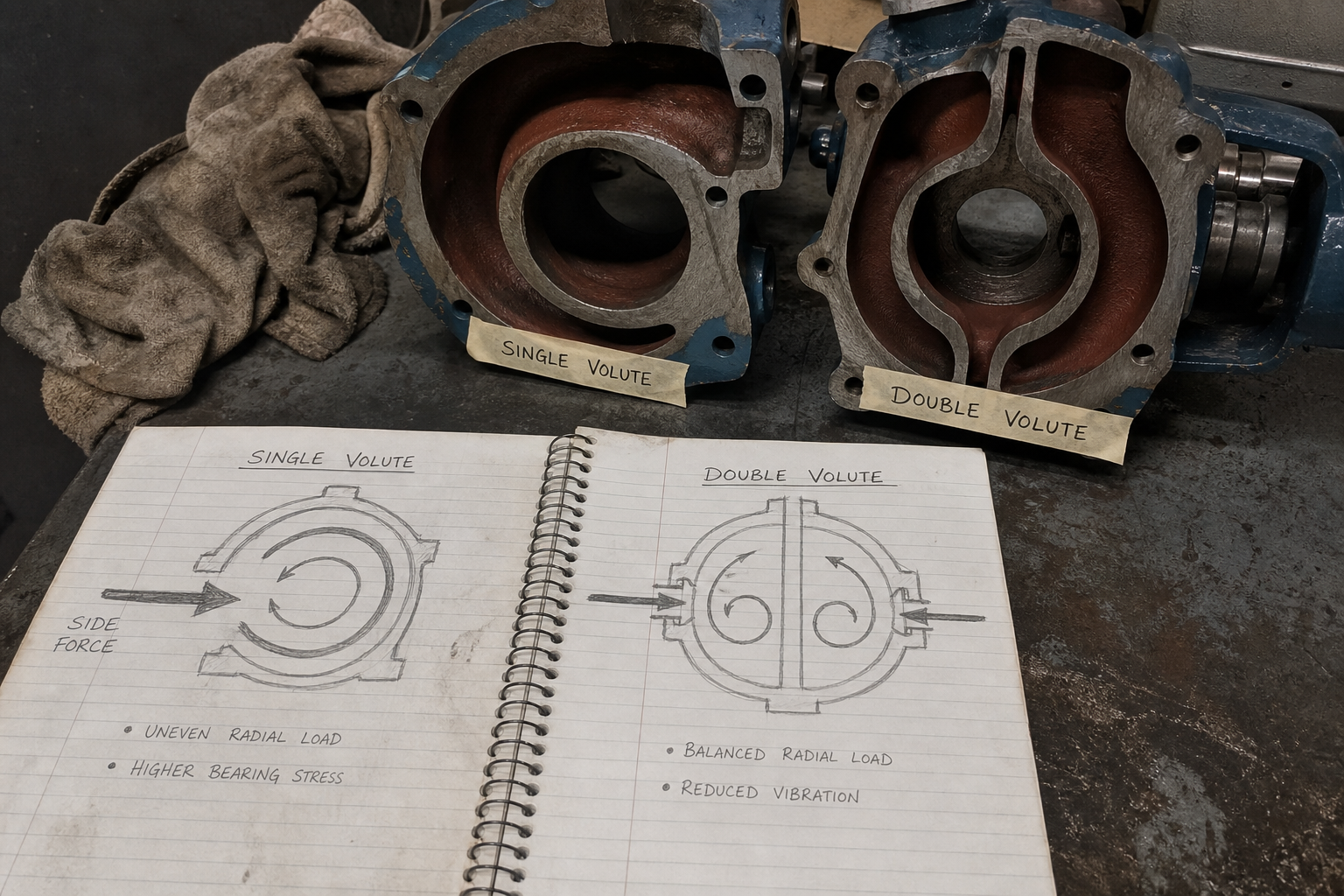
Field-style article image prepared for single volute vs double volute pump.
During commissioning of a 500 HP boiler feed pump, the coupling guard showed visible vibration at 60% flow. The baseline test at BEP ran smooth, but partial-load operation triggered bearing temperature alarms within two hours. The root cause traced to radial thrust imbalance in the single-volute casing—a problem a double-volute design would have minimized.
A single volute casing collects discharge flow through one spiral chamber around the impeller, generating high radial thrust at off-BEP conditions. A double volute splits the collection path into two 180-degree chambers, balancing opposing pressure forces and reducing net radial load across the operating range. The choice between configurations depends on expected flow variation, shaft stiffness, bearing capacity, and maintenance access requirements.
Puntos clave
- Single volute casings produce maximum efficiency at best efficiency point but generate high radial thrust when flow deviates by more than 20% from BEP.
- Double volute designs reduce radial thrust to 10-25% of single-volute levels across 40-120% of BEP flow, extending bearing life and reducing shaft deflection.
- Single volute construction costs 15-30% less and allows larger maintenance access ports, making it suitable for clean water service with stable flow demand.
- Double volute casings require a flow splitter tongue that introduces a minor efficiency penalty of 1-2 percentage points at BEP but delivers superior part-load performance.
Volute Geometry and Pressure Distribution
The volute chamber converts the impeller’s kinetic energy into pressure by gradually expanding the flow cross-section. In a single volute design (https://www.sciencedirect.com/topics/engineering/volute), one continuous spiral wraps around the impeller from the cutwater tongue to the discharge nozzle. Fluid exits the impeller at high velocity and decelerates as the volute area increases according to the flow rate at each angular position.
The cutwater tongue sits at one point on the impeller periphery, creating an asymmetric pressure field. At design flow, the pressure rise around the volute roughly matches the geometry’s area progression. Off-design operation breaks this balance—lower flows leave high-pressure zones opposite the cutwater, while higher flows shift the pressure peak location.
A double volute adds a second spiral chamber and splitter tongue at 180 degrees from the primary cutwater. Each chamber handles half the total flow. The opposing pressure distributions produce radial forces that counteract rather than sum, reducing the net load on the shaft and bearings.
Radial Thrust Characteristics Across Operating Range
Radial thrust magnitude follows a predictable pattern with flow rate. At BEP, even a single volute generates minimal net force because the pressure distribution approaches circumferential symmetry. The peak radial load occurs between 40-60% of BEP flow for most centrifugal pump designs.
The relationship approximates:
**F_r = K × D₂ × B₂ × ρ × H**
Dónde:
- F_r = radial thrust force (N)
- K = thrust coefficient (0.15-0.35 for single volute, 0.02-0.08 for double volute)
- D₂ = impeller diameter (m)
- B₂ = impeller outlet width (m)
- ρ = densidad del fluido (kg/m³)
- H = pump head (m)
For a 300-mm diameter impeller pumping water at 80 m head with 50-mm outlet width, a single volute at 50% BEP generates approximately 8,500 N radial load using K = 0.30. The equivalent double volute with K = 0.06 produces 1,700 N—an 80% reduction.
This force difference translates directly to bearing loads, shaft deflection, and seal chamber alignment. Axially split casing pumps (https://customer-suite-dev.ksbusa.com/images/Resources/Know-How%20Booklets/KSB_Know-How_Axially_Split_Casing_Pumps.pdf) operating with variable flow demand typically specify double volutes to maintain bearing L10 life targets above 40,000 hours.
Efficiency and Performance Trade-offs
Single volute designs achieve peak efficiency 1-2 percentage points higher than equivalent double volute pumps. The absence of a splitter tongue eliminates one source of hydraulic loss and allows smoother flow transition from impeller to discharge. For constant-speed applications operating continuously near BEP, this efficiency advantage compounds over the pump’s service life.
The efficiency curves differ in shape as well as magnitude. Single volute pumps show a sharp peak with efficiency dropping rapidly beyond ±15% of BEP. Double volute configurations (https://www.sciencedirect.com/topics/engineering/dynamic-pump) maintain flatter efficiency profiles across 60-120% of design flow, making them superior for variable-speed drives or processes with changing demand.
The splitter tongue requires precise positioning—typically within ±2 degrees of the 180-degree centerline—to achieve balanced thrust reduction. Manufacturing tolerance stack-up can compromise double volute performance if the tongue alignment shifts during casting or welding. Quality foundries hold splitter position to ±1 degree through fixturing during pattern creation.
Selection Criteria for Single vs Double Volute Configuration
Choose single volute casings when the pump operates continuously within ±10% of BEP, the driver runs at fixed speed, and the application allows for robust bearing sizing. Municipal water distribution, constant-pressure cooling systems, and baseload condensate service fit this profile. The simpler casting reduces initial cost and the single cutwater allows larger handhole access for impeller inspection.
Specify double volutes for variable-flow applications, pumps with speed control, parallel pump operation where individual units load and unload, or any service where flow regularly drops below 70% of BEP. The radial thrust reduction justifies the added manufacturing complexity when bearing life, seal reliability, or shaft deflection limits become the failure mode.
**Selection Factor** | **Single Volute** | **Double Volute** |
Operating range | ±10% of BEP | 40-120% of BEP |
Radial thrust at 50% flow | High (K = 0.15-0.35) | Low (K = 0.02-0.08) |
Peak efficiency | 1-2% higher | Reference baseline |
Relative cost | Baseline | +15-30% |
Bearing life at part load | Limited | Extended |
Acceso para mantenimiento | Larger ports available | Constrained by splitter |
Process pumps handling slurries or abrasive fluids present a special case. The splitter tongue in a double volute creates a wear point that erodes faster than the main cutwater. Single volute casings with hard-faced cutwaters and oversized bearings often prove more economical for these duties despite the higher radial loads.
Mechanical and Installation Considerations
Shaft deflection under radial load affects seal chamber alignment and coupling runout. A single volute pump at 50% BEP can produce shaft deflection exceeding 0.15 mm at the seal faces, pushing standard cartridge seals beyond their compensation range. Enhanced pump designs (https://www.sulzer.com/-/media/files/services/rotating-equipment-services/pump-services/white-paper/enhanced_efficiency_and_reliability_a10468.pdf) address this through increased shaft diameter, shorter bearing spans, or migration to double volute casings.
Foundation loads also differ between configurations. The pulsating radial thrust in a single volute pump generates dynamic loads at running speed and vane-pass frequency. Double volutes reduce but do not eliminate these vibration sources—residual imbalance from manufacturing tolerances or wear patterns still produces time-varying forces. Foundation design should account for dynamic amplification factors based on the selected volute type and expected operating range.
Casing split orientation interacts with volute configuration. Radially split casings with single volutes place the joint perpendicular to the maximum radial load direction to minimize joint stress. Axially split casings with double volutes allow the split line to run through both splitter tongues, but this requires careful gasket compression control to prevent bypass flow between the two volute chambers.
Preguntas frecuentes
Can you convert a single volute pump to double volute by replacing the casing?
No. The impeller, shaft, bearing housing, and often the frame require redesign to accommodate the double volute’s different pressure distribution and reduced thrust loads. The conversion cost typically exceeds 70% of a new pump price. If radial thrust proves excessive in an existing single volute installation, solutions include flow control to keep operation near BEP, shaft upgrades, or bearing capacity increases.
How does volute type affect minimum flow requirements?
Both configurations require minimum continuous flow to prevent recirculation and overheating, typically 40-50% of BEP. Double volutes handle intermittent operation below minimum flow better due to lower mechanical stress from radial thrust, but neither type should run continuously below the published minimum flow limit without a bypass or recirculation line.
Do double volute pumps cost more to maintain?
Inspection access can be more restrictive due to the splitter tongue geometry, particularly for impeller removal in radially split casings. However, bearing and seal replacement intervals typically extend 50-100% compared to single volute equivalents in variable-flow service, offsetting the slightly higher service labor per intervention. Total maintenance cost over a 20-year life cycle generally favors double volutes for applications with significant part-load operation.
Conclusión
Select single volute casings when the pump operates at stable flow within ±10% of BEP and initial cost drives the decision. Specify double volutes when flow varies beyond ±20% of design, the pump operates in parallel with others, or bearing life and seal reliability control total ownership cost. Before startup, verify that operating procedures keep any single volute pump above 60% of BEP during normal operation, and confirm that bearing temperature monitoring will catch developing radial thrust problems before seal or coupling damage occurs.