
title: "Solar Pumps for Irrigation: Sizing, System Design, and Selection"
Water must arrive at the crop when needed, but solar energy peaks at noon and vanishes after sunset. A solar irrigation pump system works only when you design the complete chain: daily crop water demand sets the flow requirement, field layout and source depth set total dynamic head, those two values select the pump architecture, the pump power rating sizes the PV array, and a storage strategy—battery, elevated tank, or flexible schedule—bridges the gap between solar availability and irrigation timing. Treating the pump as a standalone product without calculating demand, head, and array capacity will leave crops under-watered or capital over-spent.
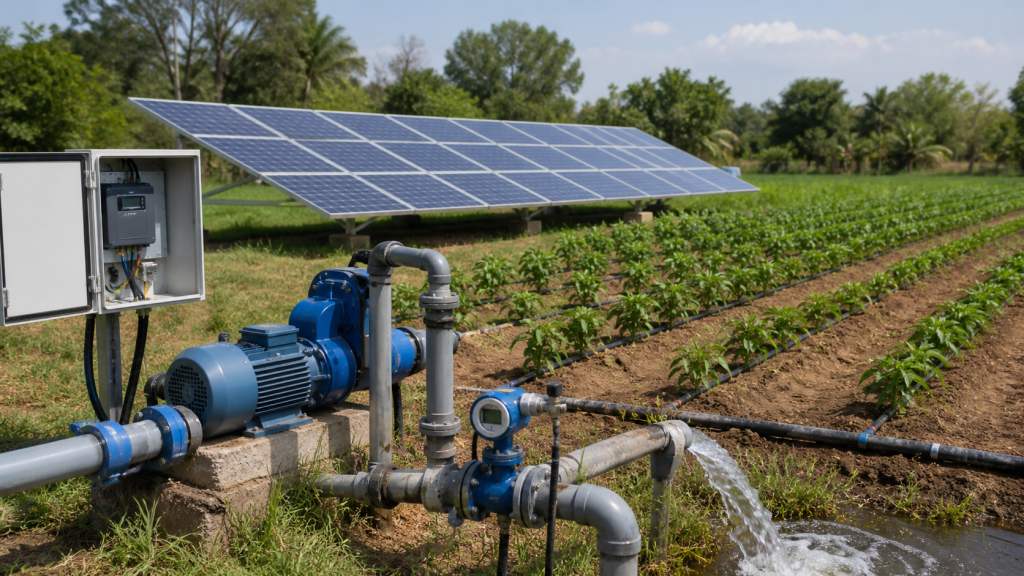
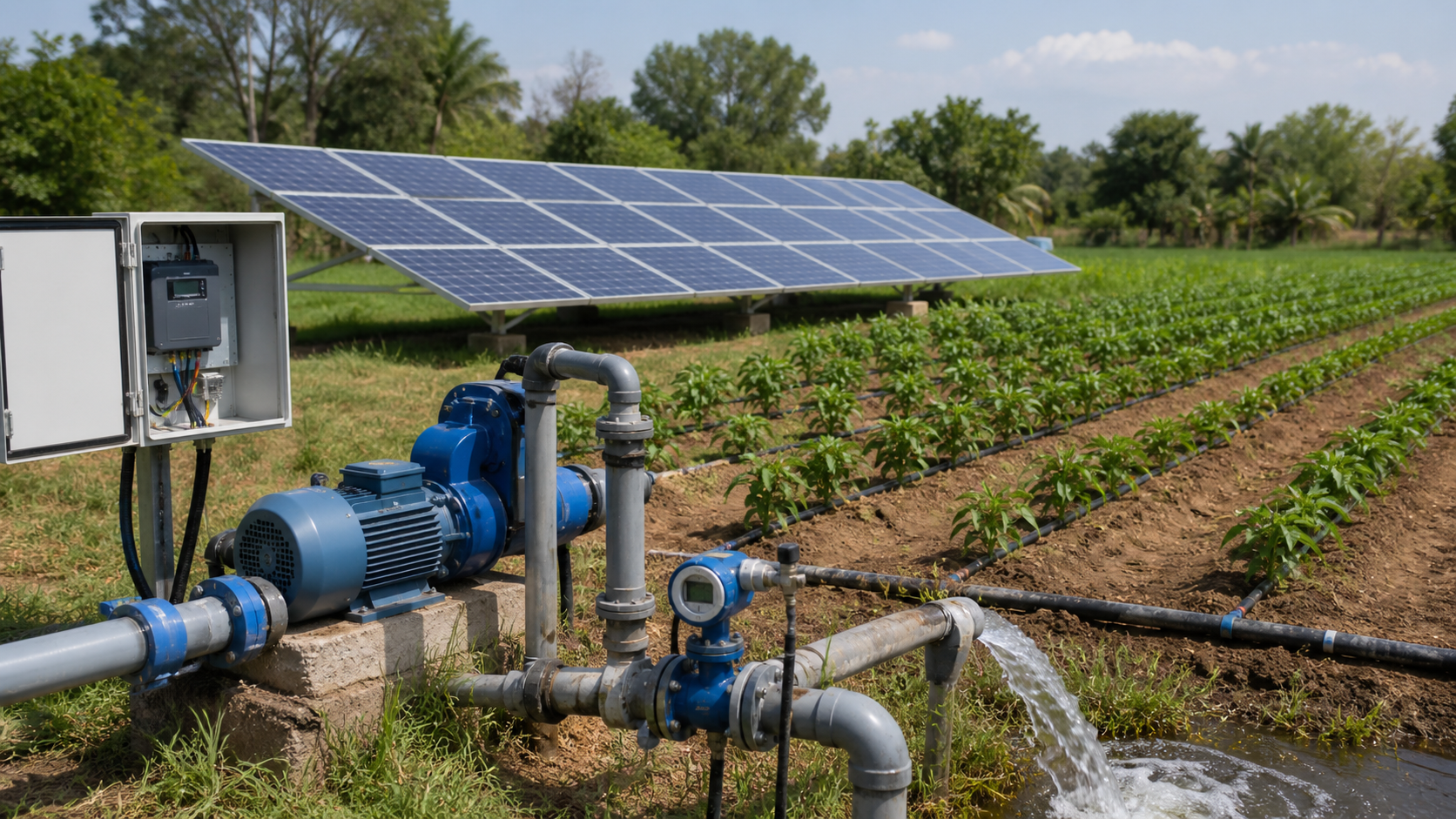
This guide walks through sizing, system design, and equipment selection for solar water pumps in irrigation applications, from smallholder surface pumps drawing from open channels to submersible well pumps serving multi-acre drip systems.
要点
- Calculate daily crop water demand in cubic meters per day, then divide by planned irrigation hours to establish design flow rate in m³/h or L/min.
- Total dynamic head is the sum of static lift, friction losses in suction and discharge piping, and delivery pressure at the field; submersible installations add dynamic drawdown.
- Surface pumps suit shallow sources and portable installations; submersible pumps handle deep wells and eliminate priming.
- Match pump input power to the solar window: a lower-power pump running longer hours delivers the same daily volume as a higher-power pump running fewer hours, assuming similar efficiency.
- PV array size must exceed pump nameplate power to compensate for temperature derating, soiling, and cable losses; an MPPT controller extracts maximum power across the day.
- Storage options include battery banks for evening irrigation, elevated tanks for gravity distribution, or scheduling irrigation within solar hours to eliminate storage cost.
Start with Daily Crop Water Demand and Irrigation Hours
Crop evapotranspiration (ETc) defines how much water the field needs each day. ETc varies by crop type, growth stage, climate, and soil. Multiply ETc by the irrigated area to get daily volume:
Daily volume (m³/day) = ETc (mm/day) × Area (ha) × 10
As a hypothetical example, a two-hectare vegetable plot with ETc = 5 mm/day needs 2 ha × 5 mm × 10 = 100 m³/day. If you irrigate during a six-hour morning window, the required flow rate is 100 m³ ÷ 6 h = 16.7 m³/h or roughly 280 L/min.
Irrigation hours constrain pump selection. Solar-powered systems run when sunlight is available. If your irrigation schedule must extend into evening—common with overhead sprinklers to reduce wind drift and evaporation—you need battery storage or an elevated tank filled during the day. Flexible schedules that follow the sun eliminate storage cost but require drip or furrow systems tolerant of midday application.
Record monthly ETc values from local extension services or weather stations. Peak demand in the dry season sizes the pump; off-season demand may allow reduced array output or shared equipment.
Convert the Field Layout into Design Flow and TDH
Total dynamic head (TDH) is the energy the pump must deliver, measured in meters of water column. TDH sums four components:
- 静揚力: Vertical distance from the water surface (or well dynamic level under pumping) to the discharge point.
- Suction friction loss: Pressure drop in the suction pipe, negligible for submersible pumps, significant for surface pumps with long or undersized suction lines.
- Discharge friction loss: Pressure drop in the delivery pipe, calculated using the Darcy-Weisbach or Hazen-Williams equation based on flow rate, pipe diameter, length, and material roughness.
- Delivery pressure: Required pressure at the field inlet—varies by irrigation method and must be obtained from the distribution system manufacturer or design specification.
For a well pump delivering to a drip manifold 50 m above the static water level, with dynamic drawdown adding another 10 m, discharge piping friction of 8 m, and manifold inlet pressure of 12 m, TDH = 50 + 10 + 8 + 12 = 80 m.
Use conservative friction factors. PVC and HDPE pipes age, biological growth increases roughness, and sediment narrows effective diameter. Size discharge piping to limit friction losses without excessive pipe cost. Higher velocities save material but increase friction loss and water hammer risk when the pump stops.
Measure static water level in wells seasonally. A well that stands at 20 m depth in the rainy season may drop to 35 m in the dry season, changing both static lift and drawdown. Design for the worst-case depth unless you plan to adjust the array or limit irrigation during peak drawdown.
Choose Surface or Submersible Pump Architecture
Surface pumps sit above ground and draw water through a suction pipe. Submersible pumps are lowered into the well and push water upward through a discharge column. The choice depends on source depth, portability needs, and maintenance access.
Surface pumps suit shallow sources where suction lift stays within the pump’s capability, limited by atmospheric pressure, vapor pressure, and friction losses. They work well for canals, ponds, rivers, and shallow hand-dug wells. They allow easy inspection, cleaning, and seasonal relocation, important for smallholder farmers rotating between fields. Portable solar pump kits pair surface pumps with fold-up PV panels and suction hoses for flexibility.
水中ポンプ handle deep wells, boreholes, and installations where suction lift exceeds surface-pump capability. Multi-stage submersibles deliver high head in compact diameters that fit drilled wells. Submersibles avoid priming problems, tolerate intermittent well recovery, and run cooler because the surrounding water dissipates motor heat. The main tradeoffs are higher initial cost and the need for lifting equipment to retrieve the pump for service.
For systems that might switch between a well and a surface source, install a surface pump with a foot valve on the suction line. The foot valve retains prime when the pump stops, allowing rapid restart without manual priming. Submersible installations cannot easily switch sources without a second pump.
Match Pump Power to the Solar Window
Pump power rating and operating hours combine to deliver the daily volume. A 1.5 kW pump running six hours per day moves the same total water as a 3 kW pump running three hours, assuming both operate near best efficiency point (BEP). However, the 3 kW pump requires a larger PV array, heavier wiring, and a controller rated for higher current. The 1.5 kW pump spreads the load across more daylight hours, allowing a smaller array and simpler power electronics, but takes longer to fill storage if needed.
Calculate required pump input power from the hydraulic duty point:
Pump input power (kW) = (Flow (m³/h) × TDH (m) × ρ (kg/m³) × g (m/s²)) / (3,600,000 × η_pump × η_motor)
For water at 20 °C, ρ = 998 kg/m³ and g = 9.81 m/s². As an example, a pump delivering 15 m³/h at 60 m head with combined pump and motor efficiency of 0.50 requires approximately (15 × 60 × 998 × 9.81) / (3,600,000 × 0.50) = 0.49 kW input. Real installations add margin for efficiency variation, cable losses, and array temperature derating.
Select a pump with its BEP close to your duty point; operating far from BEP wastes energy, increases wear, and may cause cavitation or recirculation.
Peak sun hours (PSH) measure daily solar energy normalized to 1,000 W/m². A location with 6 PSH receives the equivalent of six hours at full panel output. If the pump must deliver 90 m³/day and operates at 15 m³/h, it needs to run 6 hours. A site with 6 PSH provides just enough energy; a site with 4 PSH would require a larger array or reduced daily volume.
Check solar irradiance data for your specific location and season. Online tools like the Global Solar Atlas provide monthly PSH averages. Design for the lowest-PSH month during the irrigation season to ensure year-round performance.
Size the PV Array, Controller, and Storage Strategy
The PV array must supply pump input power plus system losses. A 1 kW pump requires an array producing more than 1 kW under standard test conditions (STC: 1,000 W/m², 25 °C cell temperature, AM 1.5 spectrum) to cover:
- Temperature derating: Panel output drops as cell temperature rises above 25 °C; consult manufacturer temperature coefficients.
- Soiling and shading: Dust, leaves, and partial shade reduce output depending on cleaning frequency and location.
- Cable and connection losses: Voltage drop in DC cables and connection resistance consume power.
- Controller efficiency: MPPT controllers introduce conversion losses.
Connect panels to maximize voltage rather than current; higher voltage reduces cable losses and matches the MPPT controller’s input range. Consult manufacturer specifications for array configuration limits.
An MPPT solar pump controller adjusts the electrical load on the PV array to extract maximum power as irradiance and temperature change throughout the day. Without MPPT, a fixed-load pump would draw constant current, forcing the panels off their peak-power point during morning, evening, and cloudy periods. The controller also provides soft-start, dry-run protection, and low-voltage cutoff to protect the pump.
Storage options depend on irrigation timing:
- No storage: Irrigate only during solar hours. This is the lowest-cost approach and suits drip systems, which can apply water slowly across the middle of the day. Daily volume is limited by PSH.
- Elevated tank: Pump water into a tank during the day, then irrigate by gravity in the evening or at night. Tank volume should cover at least one full irrigation cycle. This approach works well for sprinklers and provides pressure without electrical storage.
- Battery bank: Store electrical energy for evening pumping. Batteries add significant cost, require maintenance, and have finite cycle life. Use batteries only when elevated tanks are impractical and evening irrigation is mandatory.
Most solar irrigation pumps for small farms operate without batteries, relying on daytime pumping to fill tanks or ponds.
Drip, Sprinkler, and Open-Channel System Differences
Irrigation method affects head requirements, flow uniformity, and pump control strategy.
Drip systems operate at low pressure and deliver water slowly through emitters. The pump can run continuously during solar hours, and a small pressure tank smooths flow pulsations. Drip systems tolerate variable flow rates as sunlight changes, so the pump can ramp with solar intensity without harming the crop. Filtration is critical; sand and organic matter clog emitters. Install a screen filter on the discharge line before the drip manifold; consult the emitter manufacturer for required filtration level.
Sprinkler systems require higher pressure and uniform flow to maintain coverage patterns. Operating pressure must stay within design tolerance, or the spray radius and application rate change. A pressure-regulating valve or a controller with closed-loop pressure feedback maintains setpoint as solar input varies. Sprinklers work best with battery storage or tank-fed systems so irrigation can run at dawn or dusk when wind is low.
Open-channel and furrow systems need zero delivery pressure; the pump simply lifts water to the field elevation and discharges into a canal or basin. TDH is lower, reducing pump power requirements, but flow rate must be high enough to prevent infiltration losses during conveyance. These systems suit flood-irrigated crops and are common with surface pumps drawing from rivers or ponds.
Pump control differs by method. Drip systems benefit from variable-speed operation tracking solar power, while sprinklers need fixed-speed operation with storage. Open channels can accept pulsed flow if the canal has storage capacity.
Protect against Dry Run, Low Sun, and Blocked Flow
Solar pump systems face three failure modes: running dry when the source depletes, stalling in low irradiance, and overheating when flow is blocked.
Dry-run protection prevents the pump from running without water, which destroys mechanical seals, bearings, and motor windings rapidly. Submersible installations should include a level sensor or float switch that cuts power when the water level drops below the pump intake. For surface pumps, a pressure switch on the discharge line detects loss of prime and stops the motor. Controllers with dry-run inputs automatically restart the pump when the well recovers, useful for wells with low yield that need periodic rest.
Low-irradiance stall occurs when solar power falls below the pump’s minimum start threshold. Most controllers have a configurable start voltage to prevent the motor from drawing locked-rotor current in dim light. During cloudy weather or early morning, the pump may cycle on and off repeatedly. Set the start threshold above the voltage at which the motor begins to turn. The controller should also have a restart delay to prevent rapid cycling.
Blocked-flow overpressure happens when a valve closes downstream or the discharge line clogs. With nowhere for the water to go, pressure rises to the pump’s shutoff head, and flow ceases. The pump continues to run, spinning water inside the casing and generating heat. Most solar pump controllers monitor motor current; a sudden drop in current with rising voltage indicates blocked flow, and the controller stops the pump. A manual reset or inspection is required before restart. Always install a pressure relief valve sized to the pump’s maximum flow on the discharge header to protect against valve closure.
Combine these protections with regular inspection. Check suction screens frequently in silty water, verify that float switches move freely, and test the pressure relief valve monthly.
Solar Irrigation Design Data Sheet
Use this checklist to collect the information needed for pump and array specification:
パラメータ | Value | 単位 | Notes |
|---|---|---|---|
Crop type and area | ha | ||
Daily ETc (peak month) | mm/day | From local data | |
Daily water requirement | m³/day | ETc × area × 10 | |
Planned irrigation hours | h/day | Solar window or scheduled | |
Design flow rate | m³/h or L/min | Volume ÷ hours | |
Source type | Well, pond, river, canal | ||
Static water level (worst case) | m below grade | For wells | |
Dynamic drawdown | m | From well test | |
Total static lift | m | ||
Discharge pipe length and diameter | m, mm | ||
Estimated friction loss | m | From calculation or chart | |
Required delivery pressure | bar or m | From system specification | |
Total dynamic head (TDH) | m | Sum of above | |
Pump architecture | Surface or submersible | ||
Estimated pump efficiency | % | From curve or assumption | |
Calculated pump input power | キロワット時 | Hydraulic power ÷ efficiency | |
Specified pump power | キロワット時 | Rounded up to available size | |
Location and season | |||
Peak sun hours (lowest month) | h/day | From solar data | |
Array size (STC) | キロワット時 | With appropriate margin | |
Panel configuration | Series/parallel arrangement | ||
Controller type | MPPT, dry-run, low-V cutoff | ||
Storage method | None, tank, battery | ||
Tank or battery capacity | m³ or kWh | If used |
Fill this sheet before requesting quotes. Manufacturers need TDH, flow, and power to select the correct pump model and provide a validated curve.
よくある質問
Can I run a standard AC irrigation pump on solar panels?
Not directly. Standard AC pumps require grid-frequency power (50 or 60 Hz), which solar panels do not provide. You need either a DC solar pump with a matching MPPT controller, or an AC pump with a solar inverter. Solar inverters for pumps must handle high inrush current during motor start, so a soft-start inverter or variable-frequency drive is required. DC pumps are more common for off-grid irrigation because they eliminate the inverter and operate more efficiently at partial power.
How much water can a 1 kW solar pump deliver per day?
It depends on TDH and peak sun hours. A 1 kW pump running at 50 % efficiency delivers 0.5 kW of hydraulic power. At 30 m TDH, that moves approximately 6 m³/h, and with 6 peak sun hours per day, daily volume is 36 m³. At 60 m TDH, the flow rate halves to 3 m³/h, and daily volume drops to 18 m³. Higher head means lower flow and lower daily volume for the same pump power. Actual performance depends on the specific pump curve and operating conditions.
Do I need a battery for a solar irrigation pump?
Only if you must irrigate outside solar hours and cannot use an elevated storage tank. Batteries add capital cost, maintenance, and replacement cycles. Irrigating during the day eliminates battery cost. If your crop requires evening or night application, fill a tank during the day and irrigate by gravity later, or accept the battery expense for evening pumping.
What happens to the pump on cloudy days?
The pump delivers less water because solar irradiance is reduced. On a partly cloudy day, the pump may run at reduced speed and deliver lower flow. On heavily overcast days, irradiance may fall below the controller’s start threshold, and the pump will not run at all. Size the system for average conditions in the irrigation season, and accept occasional low-output days, or add battery storage to buffer weather variability.
How do I prevent the well from running dry?
Install a water-level sensor or float switch that cuts power when the water drops below a safe level. For wells with low yield, program the controller to run the pump intermittently so the aquifer can recharge between cycles. Monitor water level during peak demand. If the well consistently runs dry, either reduce daily pumping volume, deepen the well if feasible, or add a second source.
結論
A solar pump for irrigation is not a standalone device but the heart of a system spanning crop water needs, hydraulic design, solar resource, and storage strategy. Start with daily volume and convert it to flow rate based on available solar hours. Calculate TDH from field elevation, pipe friction, and delivery pressure. Choose surface or submersible architecture based on source depth and portability needs. Match pump power to the solar window, then size the PV array with margin for losses. Decide whether to irrigate during solar hours, fill a tank, or invest in batteries. Finally, protect the system against dry run, low sun, and blocked flow. Fill the design data sheet with measured site conditions—static level, ETc, and PSH—and request pump curves and controller specifications from manufacturers that match your calculated duty point.