
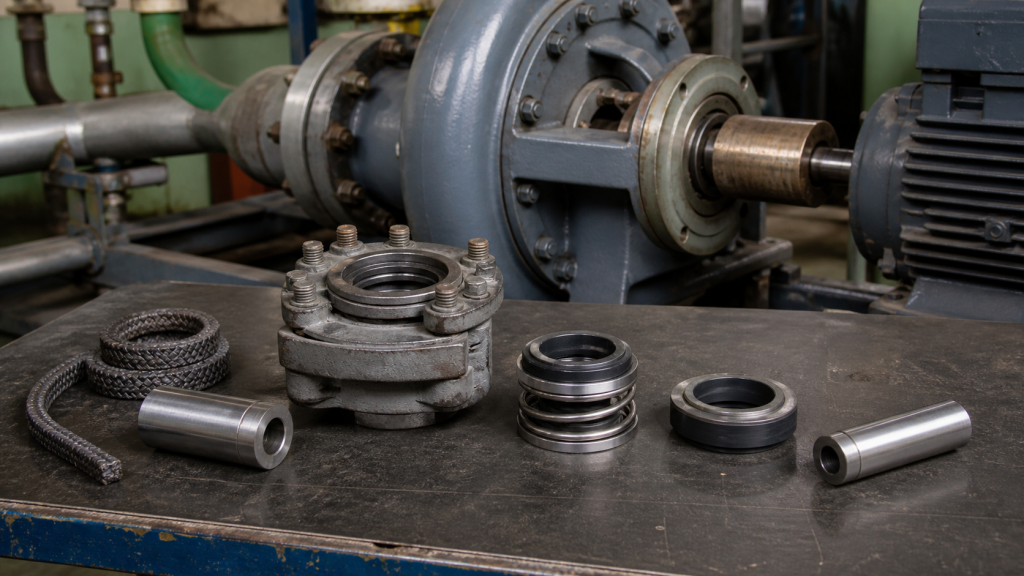
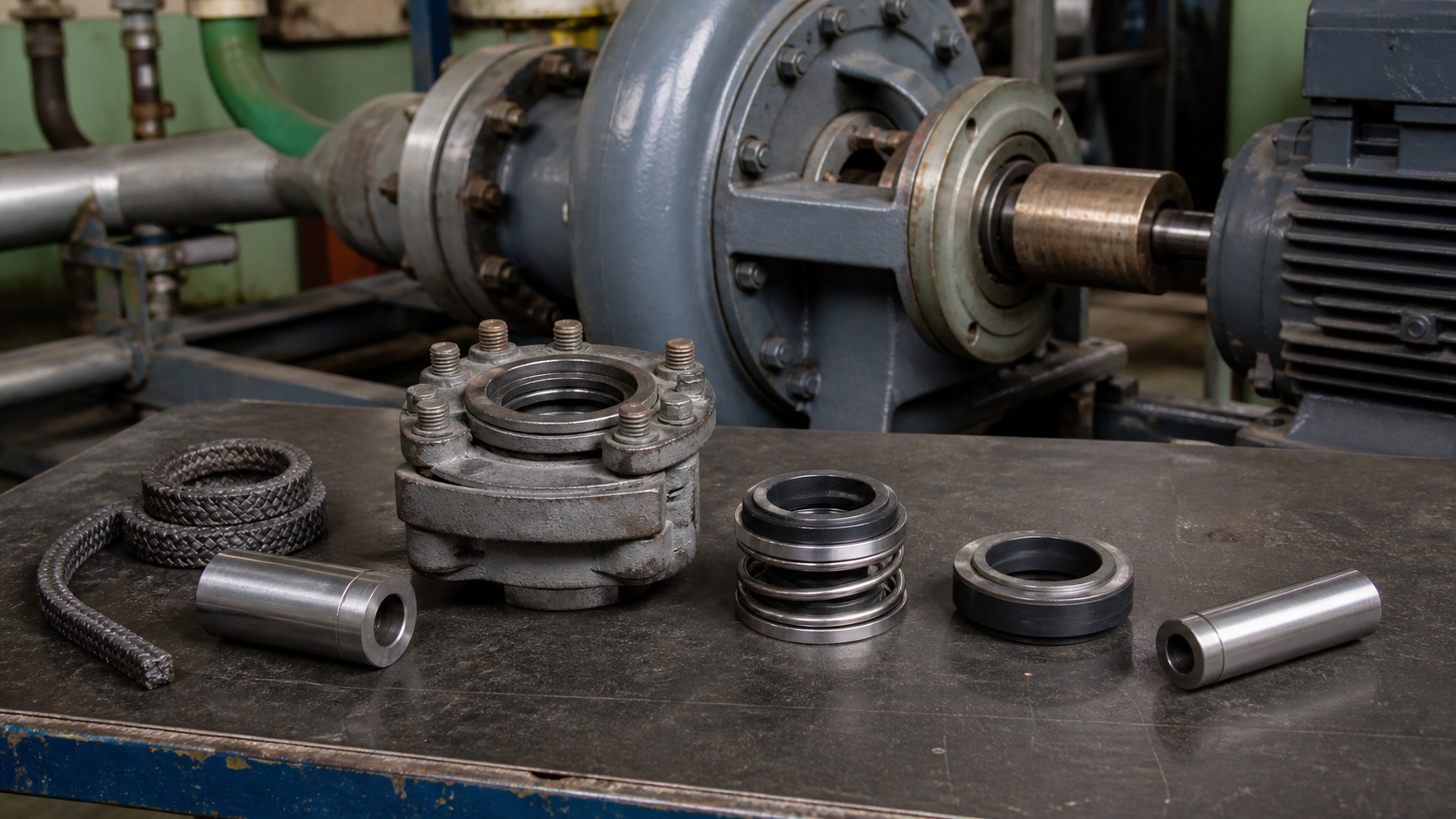
Place a packed stuffing box and a mechanical seal chamber on the same pump shaft, run them at identical speed and pressure, then measure where the energy goes. The packed box will leak by design—that controlled weepage lubricates and cools the packing rings and flushes away heat generated at the shaft interface. The mechanical seal will show zero visible leakage under the same conditions because rotating and stationary seal faces maintain a microscopic liquid film through precision lapping and spring force. Both methods seal the gap between a rotating shaft and a stationary pump casing, but packing trades deliberate leakage for simplicity and tolerance of abrasives, while mechanical seals trade installation precision and flush requirements for near-zero emissions and longer intervals between interventions.
The choice hinges on whether your service prioritizes leak containment, energy efficiency, and unattended operation—or values low first cost, field adjustability, and resilience to solids and alignment variation. This guide walks through the operating principles, quantifies the performance and cost differences, and provides a selection matrix keyed to fluid properties and duty cycle.
Key Takeaways
- Packing requires controlled leakage to maintain a lubricating film and prevent overheating; mechanical seals hold leakage below detectable levels through precision face contact.
- Shaft sleeve wear under packing accumulates faster than under mechanical seals due to continuous abrasive contact, requiring periodic sleeve inspection and eventual replacement.
- Mechanical seals demand tighter installation tolerances for shaft runout and perpendicularity—consult the seal manufacturer’s installation drawing for specific limits—while packing accommodates greater runout without immediate failure.
- Lifecycle cost comparison depends on leak disposal costs, water value, energy rates, and maintenance labor availability; packing has lower first cost, seals typically have lower operating cost in clean continuous-duty services.
- Abrasive slurries and misalignment favor packing; volatile organics, high stuffing-box pressure, and zero-emission mandates favor mechanical seals with appropriate flush plans.
Packing and Mechanical Seals Control Leakage Differently
Packing consists of braided or formed rings of graphite, PTFE, aramid fiber, or composite material compressed into a stuffing box by a gland follower. The gland is tightened until the packing expands radially against both the shaft sleeve and the box bore, creating a tortuous path that restricts—but does not eliminate—liquid flow. A thin film of pumped liquid reaches the shaft surface, providing lubrication and heat removal. Without this film, friction generates enough heat to degrade organic fibers, melt PTFE, and score the sleeve.
A mechanical seal uses two flat, lapped faces—one rotating with the shaft, one stationary against the gland plate—held in contact by spring force and hydraulic pressure. The faces are typically silicon carbide, tungsten carbide, or carbon graphite, lapped to minimize surface irregularities. When the seal runs, a microscopic liquid film separates the faces, generated by surface topography, thermal distortion, and dynamic pressure. This film carries away frictional heat while maintaining a seal that leaks less than detectable amounts under normal conditions.
The fundamental difference is intent: packing is designed to leak in a controlled manner, mechanical seals are designed to contain the pumped fluid with minimal loss.
Contact Surfaces, Compression, and Liquid Film
Packing seals through distributed compression. A typical stuffing box holds multiple rings of packing stacked with staggered splits to block a direct leakage path. As you tighten the gland nuts, the packing deforms and fills the annular space. The contact pressure at the shaft surface depends on gland torque, packing modulus, and the number of rings. Over-tightening generates excessive friction and heat; under-tightening allows uncontrolled leakage. The correct adjustment produces visible dripping—enough to wet the shaft and flush particles, not so much that it wastes pumped fluid or creates a safety hazard. Consult the packing manufacturer’s installation instructions for the target leakage rate for your shaft diameter and service.
Mechanical seal faces operate under controlled unit loading. A typical single inside seal maintains face contact across the operating envelope through spring load and hydraulic forces. When the pump runs, hydraulic closing force from stuffing-box pressure adds to the spring load, while hydraulic opening force from the pressure distribution across the seal faces partially counteracts it. The balance ratio—the ratio of areas exposed to closing versus opening pressure—is engineered to maintain stable face contact. A balanced seal runs at a lower balance ratio; an unbalanced seal operates at higher ratios. Excessive closing force overheats the faces; insufficient closing force allows the faces to separate and leak. Verify the balance ratio and pressure limits with the seal manufacturer for your application.
The liquid film between seal faces is self-regulating: if the faces run too close, friction increases, generating heat that causes thermal distortion and opens a gap; if the gap opens too wide, hydraulic closing force and spring load push the faces together. This dynamic equilibrium maintains a thin film under stable conditions.
Expected Leakage and Containment Requirements
Packing leakage is intentional and visible. The specified rate varies with shaft diameter, speed, stuffing-box pressure, and packing type—check the manufacturer’s installation instructions for your service. In practice, leakage increases over time as packing wears and compresses. Operators retighten the gland periodically to restore sealing, but after several adjustments the packing must be replaced. Replacement intervals depend on service conditions.
This leakage is acceptable where the pumped fluid is non-toxic, inexpensive, and discharged to a drain or containment sump. It becomes problematic when:
- The fluid is volatile, toxic, or flammable, requiring vapor containment and cleanup.
- Water is scarce or costly, and continuous loss accumulates.
- The installation is indoors or in a clean environment where dripping creates housekeeping issues.
- Environmental permits limit fugitive emissions or require containment.
Mechanical seals reduce leakage substantially. A properly installed and operated seal in clean service will leak less than detectable amounts—essentially invisible. Actual leakage depends on face materials, balance ratio, stuffing-box pressure, and flush conditions. Mechanical seals meet stricter containment requirements than packing and are often mandated by environmental or safety regulations for hazardous services.
Flush, Cooling, Solids, and Dry-Running Sensitivity
Packing tolerates solids and momentary dry running better than mechanical seals because the contact area is distributed over several rings, and the lubricating film comes directly from the pumped fluid. If the pump loses prime briefly, residual liquid in the stuffing box continues to lubricate the packing, buying time to restore flow. If the fluid contains sand, grit, or fibrous solids, the particles may embed in the soft packing material rather than immediately scoring the shaft sleeve, though abrasive wear still occurs. Packing can handle slurries with moderate solids content if the particles are softer than the sleeve material.
Mechanical seals are more sensitive to process upsets. The seal faces rely on a continuous liquid film for lubrication and cooling. If the pump runs dry, the liquid film evaporates, face temperatures rise rapidly, and the faces experience destructive contact wear or thermal damage. If solids enter the seal chamber, hard particles wedge between the faces, causing immediate scoring and leakage. Fibrous solids can jam the seal’s sliding components or clog flush ports.
To protect mechanical seals in difficult services, flush plans are specified according to API 682. Common configurations include:
- Plan 11 (recirculation from pump discharge back to seal chamber): simplest, works for clean liquids above vapor pressure.
- Plan 13 (recirculation through external heat exchanger): used when stuffing-box temperature exceeds face material limits.
- Plan 32 (external flush from clean source): required for slurries or liquids that crystallize or polymerize.
- Plan 53A/B (pressurized barrier fluid in dual seal): isolates the process fluid entirely for toxic or high-temperature services.
Each flush plan adds cost, complexity, and maintenance points. Packing requires no external flush system in most water services, though a lantern ring with bleed connection may be needed at higher stuffing-box pressures.
Shaft Sleeve Wear, Friction, and Energy
Packing causes continuous wear on the shaft sleeve because the braided rings maintain physical contact with the rotating surface. Wear rate depends on packing material, gland compression, shaft speed, and abrasive content. Lower friction in mechanical seals translates to measurable energy savings and less heat input to the pumped fluid.
In clean water service, wear accumulates gradually. In abrasive slurry service, wear accelerates, requiring more frequent sleeve inspection and eventual replacement or shaft repair. Track sleeve diameter over time using a micrometer or inside caliper to predict when replacement will be needed.
Mechanical seal faces wear at a lower rate because the faces operate with minimal direct contact when a proper liquid film is maintained. Hard-face materials like silicon carbide and tungsten carbide in clean service can run for extended periods before face wear causes leakage. The primary wear mechanism is gradual polishing rather than gouging. Carbon graphite faces are softer and wear faster but accommodate misalignment better.
Friction power loss under packing depends on gland compression, number of rings, shaft diameter, and speed. This heat must be carried away by the leakage flow; insufficient leakage leads to overheating and packing failure. Mechanical seals typically dissipate less power under comparable conditions due to lower face pressure and smaller contact area. The difference matters in services where temperature rise affects viscosity or vapor pressure.
Adjustment, Replacement, and Failure Consequences
Packing requires periodic adjustment as it wears and compresses. The gland is tightened in small increments to restore controlled leakage. Overtightening causes rapid wear and overheating; undertightening causes excessive leakage. Adjustment frequency depends on service severity. When the gland bottoms out against the stuffing box, the packing set must be replaced. Replacement involves:
- Isolating and draining the pump.
- Removing the gland and extracting the old packing rings with a hook or corkscrew tool.
- Cleaning the stuffing box and inspecting the shaft sleeve for scoring or wear.
- Installing new rings one at a time with staggered splits, using a split bushing or mandrel to avoid damage.
- Hand-tightening the gland, starting the pump, and adjusting to the target drip rate while running.
Field adjustability is packing’s primary advantage in remote or understaffed installations.
Mechanical seals cannot be adjusted while running. Once installed, the seal operates until it leaks, at which point it must be replaced. Replacement requires:
- Isolation, draining, and lockout/tagout.
- Disassembly of the pump to access the seal chamber, which may require pulling the motor, disconnecting piping, and lifting the casing.
- Removing the old seal, cleaning the seal chamber and shaft, and inspecting for corrosion, wear, or damage.
- Installing the new seal according to manufacturer dimensions: setting the correct shaft shoulder-to-face dimension, checking shaft runout and perpendicularity per the installation drawing, and verifying gasket seating.
- Reassembling the pump, filling the seal chamber with flush fluid, venting air, and starting per procedure.
Installation errors—wrong face gap, excessive shaft runout, misaligned gland, trapped air—cause immediate failure. Mechanical seals are more sensitive to installation mistakes than packing, requiring trained personnel and measurement tools.
When packing fails, leakage increases gradually. The operator tightens the gland until adjustment runs out, then schedules replacement during the next planned outage. When a mechanical seal fails, leakage goes from near zero to unrestricted quickly. If the stuffing-box pressure is high, the sudden leak can drain the pump casing, cause the pump to run dry, and damage the impeller and bearings before anyone notices. This failure mode requires leak detection and automatic shutdown interlocks in critical services.
Cost Is a Lifecycle Decision
First cost for packing is lower: a packing set and lantern ring represent a modest investment, and installation requires no special tools. A mechanical seal for the same shaft costs several times more for a standard single cartridge seal, and substantially more for an API 682 dual seal with instrumentation. Installation requires precision measurement tools.
Operating cost comparison depends on service-specific factors. Packing’s continuous leakage, frequent adjustment, and shaft wear accumulate cost over time through:
- Water loss (where applicable)
- Energy dissipation from friction
- Adjustment labor
- Periodic packing replacement
- Eventual sleeve replacement
Mechanical seal operating cost includes:
- Minimal water loss
- Lower friction energy loss
- Seal replacement labor and parts
The crossover point where cumulative mechanical seal cost falls below packing cost depends on local energy rates, water costs, labor availability, and service severity. In many clean continuous-duty services, mechanical seals show lower lifecycle cost after an initial payback period. The calculation shifts when service conditions shorten seal life: in abrasive slurries, a mechanical seal may fail frequently, while packing can be adjusted and replaced as needed. In volatile or toxic services, the cost of emissions management or environmental compliance makes mechanical seals necessary regardless of first cost.
To estimate lifecycle cost for your installation, track current packing adjustment frequency, replacement intervals, sleeve wear, and leakage volume. Compare these measured values to the projected cost of a seal conversion with the appropriate flush plan and installation support.
Selection Matrix by Fluid and Duty
Service Condition | Packing | Mechanical Seal | Notes |
|---|---|---|---|
Clean cold water, ambient pressure | Acceptable | Preferred | Seal provides lower lifecycle cost and minimal leakage. |
Clean hot water | Acceptable with cooling | Preferred with Plan 13 flush | High temperature shortens packing life and increases adjustment frequency. |
Slurry, moderate solids content | Preferred | Requires Plan 32 flush | Solids score seal faces; packing tolerates embedment. |
Volatile organic (VOC), flammable | Not recommended | Required | Packing leakage creates fire and vapor hazard. |
High stuffing-box pressure | Lantern ring injection required | Preferred with balanced seal | Verify seal pressure rating; packing requires intermediate pressure feed. |
Frequent starts/stops | Preferred | Acceptable with hard faces | Packing tolerates transients better. |
Continuous duty, unattended | Not recommended | Preferred | Packing requires periodic adjustment; seals run for extended periods. |
Low pressure, suction lift | Acceptable | Preferred | Verify priming and air-handling capability. |
If shaft runout exceeds seal manufacturer limits, packing is more forgiving. If emissions must meet environmental regulations, a mechanical seal is typically mandatory. If the pump will be installed in a remote location with limited maintenance support, packing offers field adjustability that may justify higher operating cost.
FAQs
Can you convert a packed pump to a mechanical seal without changing the casing?
Most horizontal and vertical pumps accept both packing and mechanical seals in the same stuffing box, but conversion requires verifying dimensions: the stuffing-box bore diameter, depth, and gland bolt pattern must match the seal gland. The shaft must have a smooth, concentric sealing surface—if the sleeve is worn from packing, it must be replaced or repaired to meet seal runout specifications. The pump must provide flush connections and a way to vent trapped air from the seal chamber. Older pumps may require a retrofit gland plate with flush ports and instrumentation taps. Consult the pump manufacturer’s seal chamber drawing and the seal supplier’s installation instructions before ordering parts.
What happens if a mechanical seal runs dry?
The liquid film evaporates, face temperature rises rapidly, and the seal fails. Hard-face materials may crack from thermal shock. Soft faces wear away quickly. The seal then leaks, draining the pump casing and potentially damaging the impeller, bearings, and motor if the pump continues to run. Dry-running protection requires low-flow cutoff switches, seal chamber temperature or pressure monitoring, or automatic shutdown on loss of prime.
How do you measure if packing is leaking too much or too little?
Count drops per minute from the lantern ring or gland leakoff. Use a clean container, count drops for a measured time interval, and compare to the target range specified in the packing manufacturer’s installation instructions for your shaft diameter and service. If leakage is below target, loosen the gland slightly and recheck after the pump stabilizes. If leakage exceeds target, tighten slightly and recheck. Also monitor packing temperature—if the gland feels excessively hot, leakage is insufficient and the packing is overheating. Adjust in small increments and allow time for thermal equilibrium before making further changes.
Do all mechanical seals need external flush systems?
No. A single inside seal in clean water service at moderate pressure and temperature can run on Plan 11 (recirculation from discharge) or with no flush plan if the stuffing-box pressure and temperature stay within the seal’s operating envelope. External flush is required when the pumped fluid is abrasive, crystallizes, polymerizes, or runs near its vapor pressure, or when stuffing-box temperature exceeds the face material’s thermal limit. API 682 provides guidance: if the process margin (stuffing-box pressure minus vapor pressure) is insufficient, or if fluid temperature exceeds seal limits, an external flush or quench is needed. Review the seal manufacturer’s recommendations for your specific service.
Can packing handle higher pressure than mechanical seals?
Packing can seal elevated stuffing-box pressure with a lantern ring injection to provide lubricating fluid at an intermediate pressure. Beyond certain limits, gland load becomes excessive and friction overheats the shaft. Single mechanical seals in balanced designs handle substantial pressure; above that, a double or tandem seal with barrier fluid is standard. Unbalanced single seals are limited to lower pressures due to face loading and heat generation. For very high pressure, specialized seals with hard faces, metal bellows, and barrier systems are used. Verify the pressure rating with the seal manufacturer for your application.
Conclusion
Choosing between mechanical seals and packing depends on whether your application values lowest first cost and field adjustability, or lowest lifecycle cost and minimal emissions. Packing remains appropriate for abrasive slurries, infrequent duty, and installations where trained seal mechanics are unavailable. Mechanical seals are preferred in clean continuous-duty services, volatile or toxic fluids, and where environmental or safety regulations limit leakage. Before specifying either method, verify stuffing-box dimensions, shaft runout tolerances, flush requirements, and available maintenance support against the pump manufacturer’s seal chamber drawing and the seal supplier’s installation instructions. For existing installations, measure current leakage rate, adjustment frequency, and sleeve wear to calculate actual lifecycle cost, then compare to the projected cost of a seal conversion with the appropriate flush plan.