
Field-style article image prepared for slurry pump vs centrifugal pump.
A standard centrifugal water pump fails in three months on a mining dewatering line, wearing through the impeller vanes while handling tailings with 15% solids by weight. The replacement spec calls for a slurry pump rated for 40% concentration, and the unit runs two years before the first impeller change.
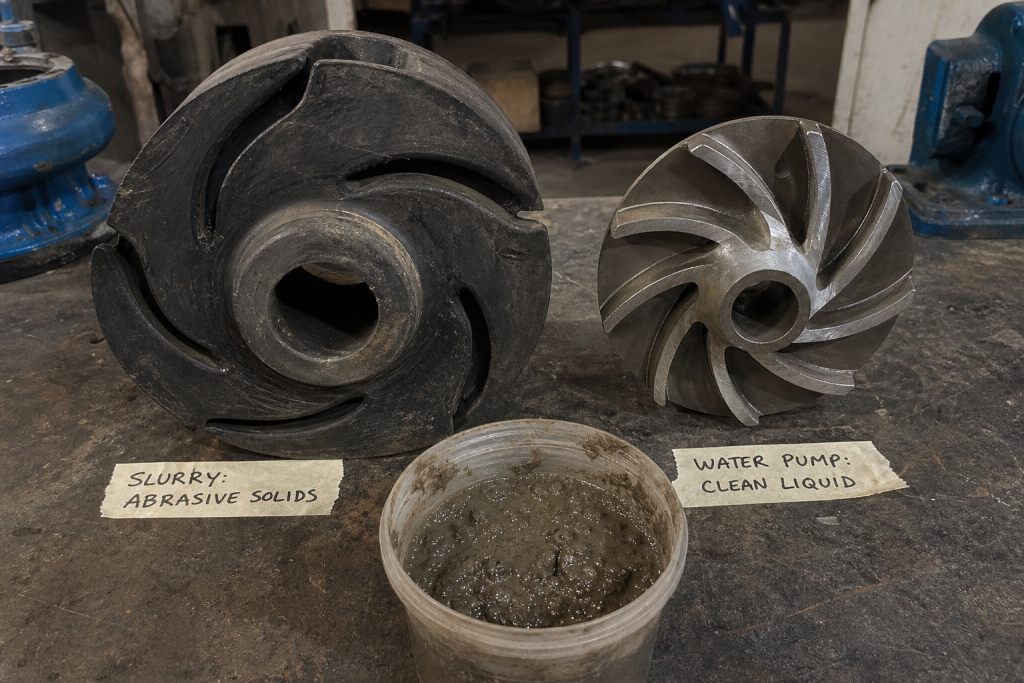
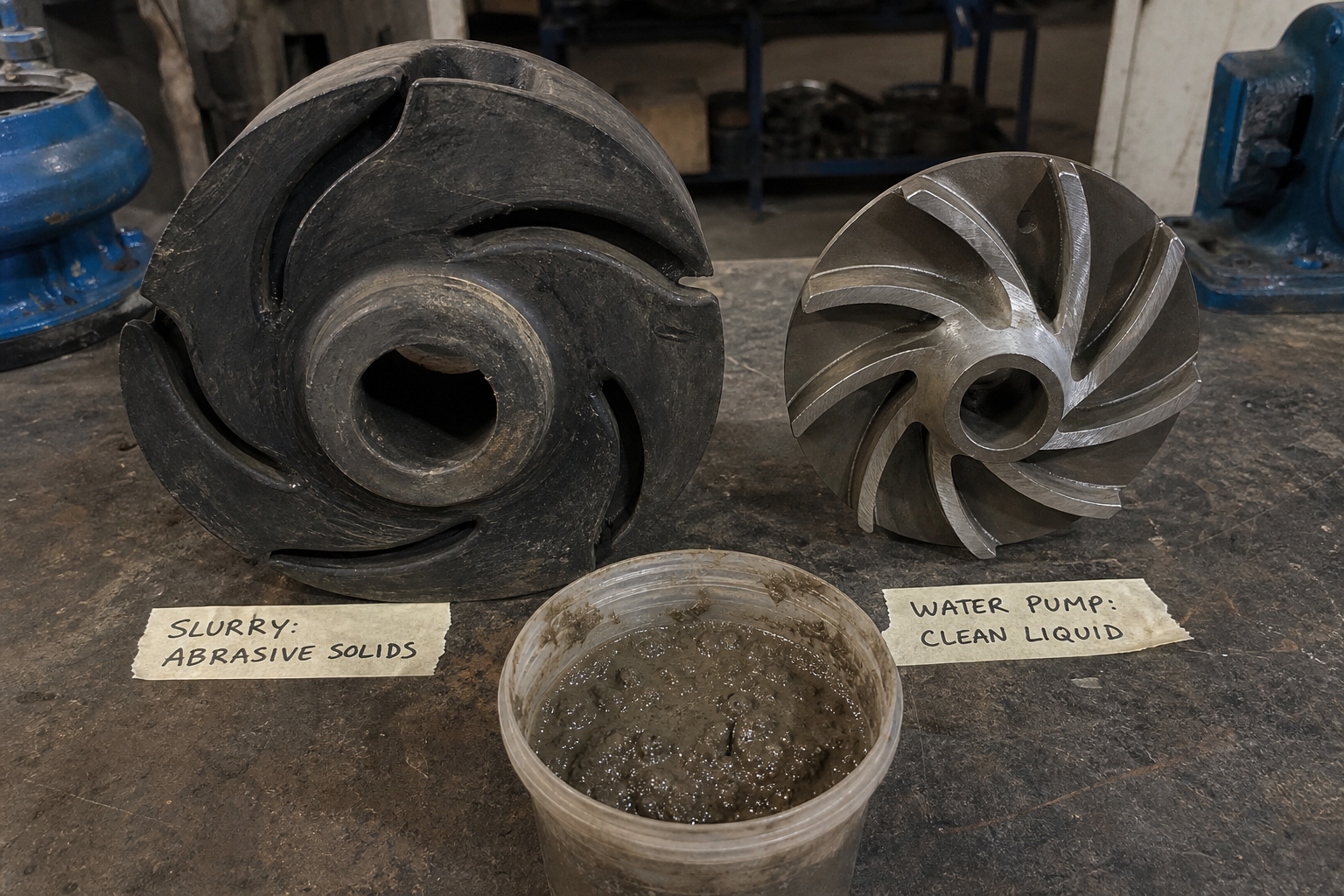
A slurry pump is a centrifugal pump built with abrasion-resistant materials, reinforced impeller geometry, and larger clearances to handle suspended solids without rapid wear. Standard centrifugal water pumps use thin-walled impellers and close tolerances optimized for clean liquid, making them vulnerable to erosion when particle-laden fluid passes through the flow path. The design split centers on wear life: slurry pumps sacrifice 5-10% hydraulic efficiency (https://bbpmfg.com/blog/slurry-pump-vs-centrifugal-pump/) to gain 10-50 times longer service in abrasive applications.
This guide covers construction differences, operating limits, wear failure modes, and the selection boundary between slurry-rated and standard centrifugal pumps for industrial fluid transfer.
Основные выводы
- Slurry pumps use hardened alloys, rubber liners, or ceramic inserts where standard centrifugal pumps use cast iron or bronze, extending wear life in abrasive service from months to years.
- Solids concentration above 8-10% by weight typically requires slurry construction; particle size, hardness, and velocity determine the threshold for any specific application.
- Impeller design trades efficiency for durability: slurry pumps accept 5-10% lower efficiency to prevent vane erosion and maintain flow over the wear cycle.
- Installation cost for slurry pumps runs 1.5-3 times higher than standard centrifugal units, justified by reduced downtime and parts replacement frequency in mining, dredging, wastewater, and industrial process lines.
Construction Differences That Control Wear Life
Standard centrifugal water pumps rely on close clearances between the impeller and casing to minimize internal recirculation and maintain efficiency. Tolerances of 0.5-1.5 mm allow high head generation but expose thin impeller vanes and wear rings to direct particle impact.
Slurry pumps use clearances of 3-8 mm and thicker vane profiles to create a buffer zone where particles can pass without grinding metal-to-metal contact. The larger gap reduces peak efficiency by 5-10 percentage points but prevents the accelerated wear that destroys standard impellers in days or weeks under abrasive conditions.
Material selection follows the hardness and angularity of the suspended solids. High-chromium white iron alloys (https://bbpmfg.com/slurry-pumps/heavy-duty-slurry-pump/) with 15-28% chromium content resist angular particles like mining tailings and coal ash. Natural rubber liners absorb impact from rounded river sand and gravel, while ceramic inserts handle fine, highly abrasive slurries in chemical processing.
Shaft sealing moves from mechanical seals to gland packing or expeller seals in many slurry applications. Abrasive particles destroy mechanical seal faces in hours, while packing tolerates grit intrusion with regular adjustment and accepts controlled leakage as part of normal operation.
Operating Condition Boundaries for Pump Selection
Solids concentration by weight provides the first selection threshold. Clean water to 2% solids runs reliably on standard centrifugal pumps with annual impeller inspection. The 2-8% range requires case-by-case evaluation based on particle characteristics and acceptable wear intervals.
Above 8-10% solids by weight, slurry construction becomes necessary for economical operation. Mining applications commonly reach 30-50% concentration, while dredging and wastewater services typically stay below 20%.
Particle size and shape determine erosion velocity more directly than concentration alone. Angular fragments below 200 mesh (74 microns) create high surface area contact that wears impeller vanes even at moderate concentration. Rounded sand particles above 1 mm require velocity control to prevent impact damage but may tolerate standard construction at lower concentrations.
Параметр | Standard Centrifugal Limit | Slurry Pump Range |
Solids concentration | 0-2% by weight | 2-60% by weight |
Maximum particle size | 200 mesh (74 µm) | Up to 50 mm depending on design |
Velocity at impeller tip | 25-40 m/s | 15-25 m/s |
Expected wear life | 3-5 years clean service | 6-24 months in severe duty |
Fluid velocity through the impeller must stay below erosion thresholds that vary with material hardness. Standard pumps operate at tip speeds of 25-40 m/s for maximum efficiency. Slurry pumps reduce tip speed to 15-25 m/s by using larger impeller diameters and lower rotational speeds, trading head per stage for wear resistance.
Wear Failure Modes and Maintenance Intervals
Impeller vane thinning marks the primary failure mode when standard centrifugal pumps handle abrasive slurries. Particles strike the vane leading edge and wear through the metal, reducing vane height and creating sharp edges that accelerate further erosion. Performance drops as internal recirculation increases, and catastrophic failure occurs when vanes separate from the hub.
Slurry pump impellers (https://bbpmfg.com/centrifugal-pumps/sludge-pump/) wear more uniformly across the flow surface, allowing predictable replacement intervals. Monitoring includes vibration analysis, power draw trending, and periodic visual inspection during scheduled shutdowns.
Casing wear creates a secondary failure path that affects both pump types differently. Standard volutes use thin walls optimized for casting economy and pressure containment. Local erosion creates holes or cracks that require immediate shutdown.
Slurry pump casings incorporate replaceable wear plates, rubber liners, or extra metal thickness in high-velocity zones. Maintenance replaces worn sections without discarding the entire casing, reducing parts cost and extending overall pump life.
Seal and bearing maintenance frequency increases with solids concentration regardless of pump type. Particles that migrate past the impeller create grinding paste in the stuffing box or mechanical seal chamber. Slurry pumps accept this reality with accessible seal designs, oversized bearing housings, and flushing systems that inject clean water to create a protective barrier.
Selection Framework for Industrial Applications
The decision to specify slurry construction starts with fluid characterization. Collect representative samples and measure solids concentration, particle size distribution, and settling velocity. Laboratory abrasion testing provides hardness data for unknown materials.
Calculate the specific gravity of the slurry using concentration and particle density. Most slurry pumps publish performance curves at multiple specific gravities, typically 1.0 (water), 1.2, and 1.4. Head and power requirements scale with density, affecting motor sizing and system design.
Evaluate the economic trade-off between initial cost and maintenance expense. A standard centrifugal pump costs $3,000-8,000 for a 100 m³/h, 30 m head duty. An equivalent slurry pump runs $5,000-15,000 depending on materials. If the standard pump requires impeller replacement every six months at $800 plus $1,500 labor and downtime cost, the slurry pump pays back in 18-24 months.
Installation factors influence the final selection beyond wear considerations. Submersible slurry pumps eliminate suction line erosion in dredging applications. Horizontal slurry pumps allow easier maintenance access in process plants. Vertical slurry pumps save floor space and handle varying sump levels in mining dewatering.
Consider system operating points across the full duty range. Centrifugal pump performance (https://changyupump.com/blog/positive-displacement-pump-vs-centrifugal-key-differences-selection-guide/) varies with flow rate, and slurry pumps show steeper head-flow curves than water pumps due to increased internal losses. Operating far from the best efficiency point accelerates wear and reduces service life for any pump type.
Вопросы и ответы
Can I retrofit a standard centrifugal pump with abrasion-resistant parts?
Some manufacturers offer hardened impellers and wear rings as aftermarket upgrades for standard frames, extending service life in mildly abrasive applications up to 5% solids. Full slurry construction requires frame geometry changes that cannot be retrofed, including larger clearances, reinforced bearings, and modified sealing arrangements that prevent direct substitution.
Do slurry pumps work with clean water or low-solids applications?
Slurry pumps operate reliably in clean water but deliver 5-10% lower efficiency than standard centrifugal pumps due to increased clearances and thicker impeller vanes. The efficiency penalty translates to higher power cost over the pump life, making slurry construction uneconomical unless abrasive service justifies the design compromises.
What maintenance schedule applies to slurry pumps in continuous service?
Heavy-duty mining applications require impeller inspection every 2,000-4,000 operating hours with replacement at 4,000-8,000 hours depending on particle abrasiveness. Wastewater and light industrial service extends intervals to 8,000-12,000 hours. Vibration monitoring and performance trending identify accelerated wear before catastrophic failure occurs.
How does velocity affect wear rate in slurry applications?
Erosion wear increases exponentially with velocity, typically following a relationship where wear rate is proportional to velocity raised to the 2.5-3.0 power. Reducing impeller tip speed from 30 m/s to 20 m/s cuts wear rate by 60-70%, explaining why slurry pumps sacrifice head and efficiency to maintain lower velocities throughout the flow path.
Заключение
Specify slurry pumps when solids concentration exceeds 8-10% by weight, particle hardness threatens rapid wear, or existing standard centrifugal pumps fail in less than annual replacement cycles. The higher initial investment delivers lower total cost in abrasive service through extended wear life, reduced downtime, and predictable maintenance intervals. Confirm fluid properties, calculate specific gravity effects on performance, and verify that system operating points stay within the manufacturer’s recommended range before finalizing pump selection and motor sizing.