
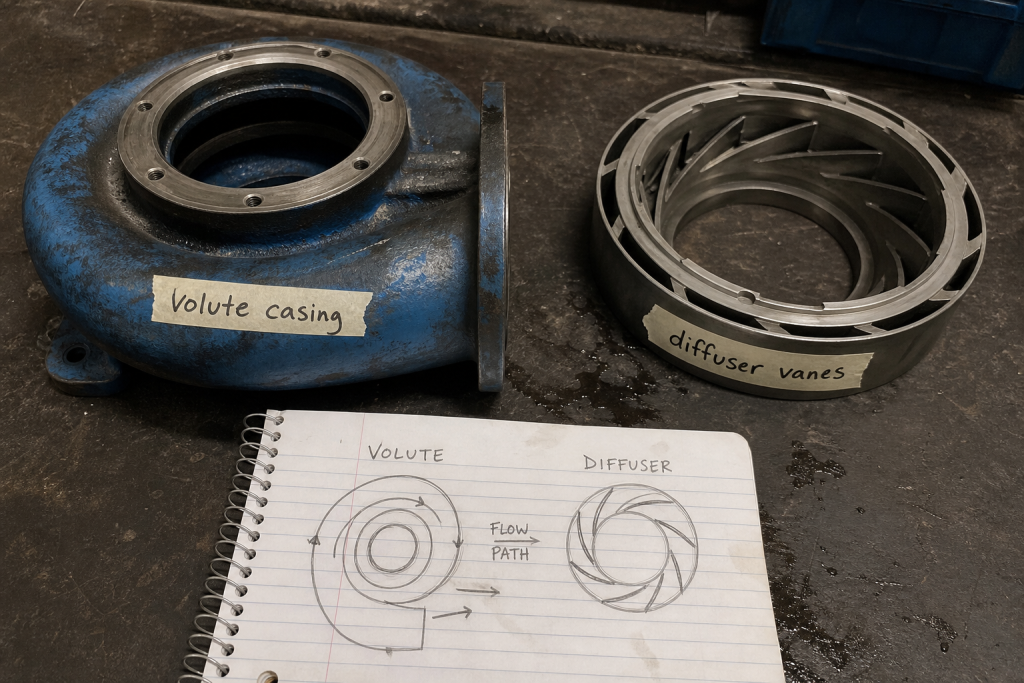
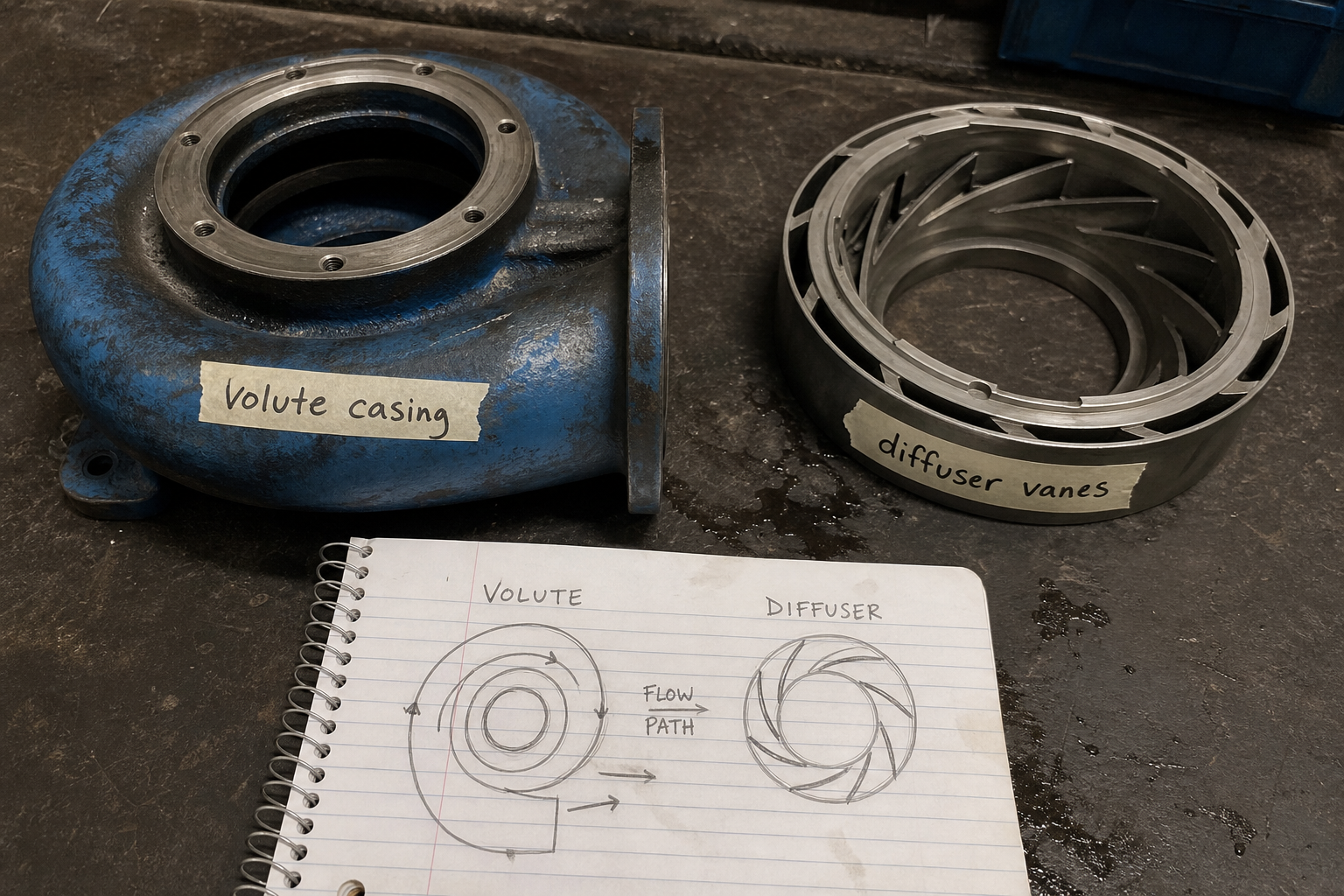
Field-style article image prepared for volute vs diffuser pump.
When you specify a centrifugal pump for a municipal water treatment plant running at variable flow, the choice between volute and diffuser casing determines whether you maintain stable efficiency or face performance penalties during turndown. A volute pump uses a spiral-shaped chamber to convert velocity energy to pressure through gradual area expansion, while a diffuser pump relies on stationary vanes surrounding the impeller to decelerate flow in controlled passages.
The core engineering difference lies in how each casing manages the kinetic energy leaving the impeller. Volute casings deliver broader operating flexibility but show steeper efficiency drops at partial flow. Diffuser casings maintain higher peak efficiency and better pressure stability when operation holds near the best efficiency point (BEP), but performance degrades more sharply when flow deviates significantly from design conditions.
Основные выводы
- Volute casings use spiral geometry for continuous pressure conversion; diffuser casings use fixed vanes to create multiple deceleration channels
- Diffuser pumps typically achieve 2-5% higher peak efficiency than volute designs at BEP, but the advantage disappears below 70% of rated flow
- Volute designs handle variable flow applications better due to flatter efficiency curves across 50-120% of BEP
- API 610 configurations (https://www.amarinth.com/library/an-explanation-of-api-610-centrifugal-pump-configurations/) classify diffuser pumps as BB3 or BB5 arrangements for refinery and petrochemical service where efficiency and radial load control justify higher cost
- Operating range, duty cycle, and control method determine which casing type delivers lower lifecycle cost
Casing Geometry and Pressure Recovery Mechanism
The volute casing forms a continuous scroll that increases in cross-sectional area as it wraps around the impeller. Fluid exiting the impeller at velocity *v₂* enters the volute tongue at minimum area *A₁* and travels through expanding passages until reaching the discharge nozzle.
The pressure rise across the volute follows Bernoulli’s equation adapted for real flow: Δp = ρ[(v₂² – v₃²)/2] – losses, where ρ is fluid density, v₂ is impeller exit velocity, v₃ is volute discharge velocity, and losses account for friction and turbulence in the spiral passage. The continuous area expansion creates a single pressure conversion path with minimal flow guidance.
Diffuser casings place 7-12 stationary vanes immediately outside the impeller exit radius. Each vane forms a diverging passage that converts velocity head to pressure head through controlled deceleration. The diffuser passages operate as small diffusers with typical included angles of 8-12 degrees to prevent flow separation while maximizing pressure recovery.
The diffuser pressure rise follows: Δp = ρ[(v₂² – v₄²)/2]η_d, where v₄ is velocity exiting the diffuser vanes and η_d represents diffuser effectiveness, typically 0.65-0.80 for well-designed passages. This staged conversion through multiple flow paths achieves higher pressure recovery efficiency than single-path volute designs.
Efficiency Characteristics Across Operating Range
Diffuser pumps reach peak efficiencies 2-5 percentage points higher than comparable volute designs when operating at BEP. A 12-inch diffuser pump might achieve 87% efficiency compared to 84% for a volute equivalent at the same specific speed (N_s = NQ^0.5/H^0.75, where N is shaft speed in rpm, Q is flow in m³/s, H is head in meters).
This efficiency advantage narrows rapidly during off-design operation. Studies of complex flow structures at off-design conditions (https://onlinelibrary.wiley.com/doi/abs/10.1002/ese3.1123) show diffuser passages experience flow separation and recirculation when inlet angles deviate from design values by more than 15-20 degrees. The resulting losses cancel the BEP efficiency gain below approximately 70% of rated flow.
Volute pumps maintain relatively flat efficiency curves between 50-120% of BEP. The single flow path adapts to varying flow rates without the fixed geometry constraints of diffuser vanes. This characteristic makes volute designs better suited for variable frequency drive (VFD) applications (https://www.pumpworks.com/optimizing-pump-performance-with-variable-frequency-drives-vfds/) where flow modulation demands sustained efficiency across a wide operating envelope.
Radial Thrust and Mechanical Loading
The pressure distribution around the impeller circumference creates radial thrust that loads the shaft and bearings. In volute pumps, this thrust varies significantly with flow rate because the volute tongue creates an asymmetric pressure field. Radial thrust reaches maximum values at shutoff (zero flow) and minimum near BEP, following approximately: F_r = K(Q – Q_BEP)², where K is a geometry-dependent constant.
Double volute designs split the casing into two 180-degree passages to partially balance radial loads, but this addresses a different design challenge than volute versus diffuser selection. Diffuser casings inherently produce more symmetric pressure distributions because multiple vanes surround the impeller uniformly.
The balanced loading in diffuser pumps reduces bearing loads and extends mechanical seal life in continuous-duty installations. However, this advantage matters most in large pumps (above 500 hp) or high-pressure services where bearing life and shaft deflection critically affect reliability.
Application Selection Framework
Specify volute casings when flow varies more than ±30% from design point, when multiple pumps operate in parallel with changing demand, or when initial cost constraints outweigh efficiency considerations. Municipal water distribution, HVAC circulation, and industrial cooling water systems typically favor volute designs.
Choose diffuser casings for steady-flow services where pumps run continuously near BEP, when lifecycle cost calculations justify 15-25% higher initial investment for 2-3% efficiency improvement, or when API 610 specifications mandate between-bearings designs. Refinery charge pumps, pipeline booster stations, and power plant feedwater service represent typical diffuser applications.
For services with seasonal or daily flow variation, calculate annual energy consumption at actual operating points rather than BEP. A diffuser pump with 87% efficiency at BEP may consume more energy than an 84%-efficient volute pump if the system operates below 70% flow for extended periods.
The formula for annual energy cost comparison: Cost = (ρgQH)/(3600η) × hours × $/kWh, where ρ is fluid density (kg/m³), g is gravitational acceleration (9.81 m/s²), Q is flow (m³/h), H is head (m), and η is efficiency at the actual operating point. Calculate this at multiple operating points weighted by annual run hours to determine true lifecycle cost.
Performance Stability and Control Response
Diffuser pumps exhibit steeper head-flow curves with more distinct BEP peaks. This characteristic improves system stability in fixed-speed operation by reducing the likelihood of parallel pump hunting or system oscillation. The well-defined operating point helps in selecting appropriate pump power requirements (https://www.sciencedirect.com/topics/engineering/input-pump-power) during initial design.
The steep curve becomes a disadvantage under VFD control or when system resistance changes unpredictably. Small deviations from design flow produce larger pressure changes in diffuser pumps compared to volute designs, potentially triggering control instability or requiring more sophisticated control algorithms.
Volute pumps with flatter curves tolerate system variations without dramatic pressure swings. This forgiveness makes them preferable when system resistance cannot be precisely predicted, when fouling gradually changes pipe roughness, or when operators frequently adjust flow through valve throttling rather than speed control.
Вопросы и ответы
Does a diffuser pump always cost more than a volute pump?
Initial purchase price for diffuser pumps runs 15-25% higher than volute equivalents due to increased machining complexity and tighter tolerance requirements for diffuser vane passages. However, the cost premium decreases as a percentage for larger pumps above 200 hp where casting and machining scale factors reduce relative differences.
Can I retrofit a volute casing with diffuser vanes?
Diffuser retrofits require complete casing replacement and often demand different bearing arrangements to handle the altered hydraulic loads. The impeller design also differs between casing types—diffuser impellers typically have fewer vanes with different exit angles optimized for diffuser passage entry conditions.
Which design requires less maintenance access?
Volute pumps generally offer simpler maintenance because the single-piece casing allows impeller removal without disturbing diffuser vane alignment or clearances. Diffuser assemblies require careful reassembly to maintain proper vane positioning and clearances between rotating and stationary components.
How does specific speed affect the volute-diffuser choice?
High specific speed pumps (Ns > 3,000 in US units) rarely use diffusers because the impeller exit flow angles and high relative velocities make it difficult to design effective diffuser passages. Low specific speed designs (Ns < 1,500) benefit most from diffuser efficiency gains because the lower velocities and more favorable flow angles suit controlled deceleration in vaned passages.
Заключение
Select diffuser pumps when your application runs continuously within ±20% of design flow, when system efficiency gains justify higher capital cost, or when specifications mandate API 610 compliance for critical services. Choose volute designs for variable flow duty, parallel pump installations, or when operating flexibility matters more than peak efficiency. Calculate energy costs at actual weighted operating points rather than BEP, and verify that the steeper performance curve of diffuser pumps remains compatible with your control strategy and system stability requirements.