
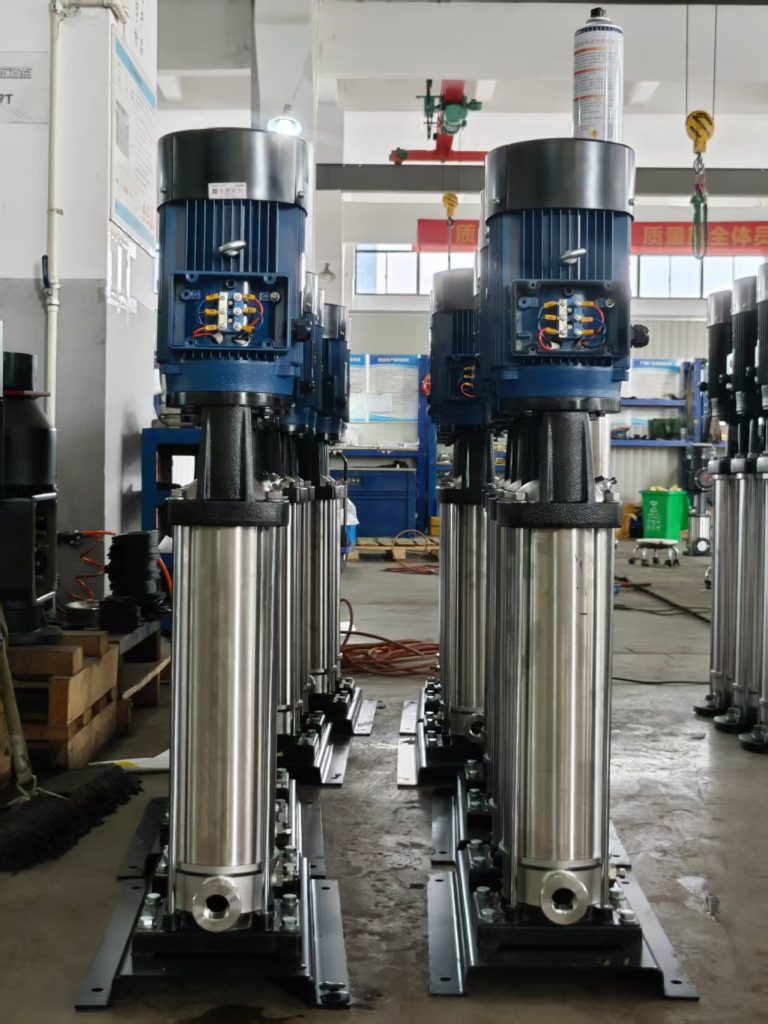
Vertical pump motor selection should begin with the pump duty point, not the motor kilowatt rating.
The motor determines the pump speed, but a change in speed also changes the hydraulic performance. Flow, head, absorbed power and suction requirements can all be affected.
Voltage, phase, frequency, ambient temperature, altitude, starting method and VFD operation must therefore be considered together. A request such as “I need a 7.5 kW motor for a vertical pump” does not provide enough information for an accurate selection.
How frequency affects motor speed
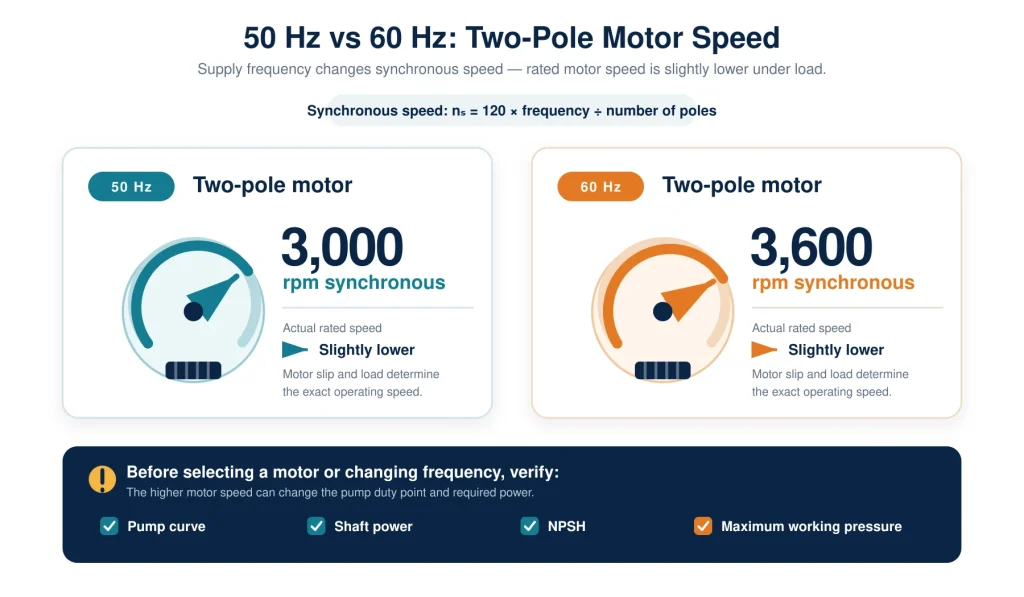
The synchronous speed of an AC motor depends on electrical frequency and the number of motor poles:
Nₛ = 120f / P
Where:
- Nₛ = synchronous speed in rpm
- f = electrical frequency in Hz
- P = number of motor poles
For a two-pole motor, the synchronous speed is 3,000 rpm at 50 Hz and 3,600 rpm at 60 Hz.
An induction motor runs slightly below synchronous speed because it requires a difference between the rotating magnetic field and rotor speed to generate torque. This difference is known as slip.
A two-pole pump motor may therefore have an actual rated speed around 2,900 or 2,950 rpm at 50 Hz and around 3,450 or 3,500 rpm at 60 Hz. The exact speed must be taken from the motor nameplate and product data.
Nidec’s motor guide provides a useful explanation of frequency, synchronous speed and induction-motor slip.
Because 50 Hz and 60 Hz motors operate at different speeds, the same pump hydraulic assembly will not necessarily produce the same flow, head or shaft-power requirement at both frequencies.
Estimating the effect of a speed change
For the same centrifugal pump, impeller diameter and liquid, the affinity laws provide an initial estimate of how performance changes with speed:
Qnew / Qrated = Nnew / Nrated
Hnew / Hrated = (Nnew / Nrated)²
Pshaft,new / Pshaft,rated = (Nnew / Nrated)³
Flow is approximately proportional to speed. Head is approximately proportional to the square of speed, while required shaft power is approximately proportional to the cube of speed.
If speed increases by 20%, as it theoretically does when moving from 50 Hz to 60 Hz, the initial estimates are:
- Flow increases to approximately 1.20 times
- Head increases to approximately 1.44 times
- Required shaft power increases to approximately 1.73 times
These figures are useful for preliminary evaluation. They should not replace the manufacturer’s performance curve for the intended frequency.
The actual operating point is determined by the intersection of the pump curve and the system curve. The U.S. Department of Energy’s variable-speed pumping guide notes that simple affinity-law calculations may produce significant errors in systems with substantial static head.
Increasing speed can also increase the pump’s NPSH requirement. This means that a pump may require better inlet conditions at 60 Hz than at 50 Hz.
Select motor power from the pump curve
Once the required flow and total dynamic head are known, the duty point can be located on the correct pump curve.
The next step is to check the shaft power required at that point and across the intended operating range. The motor must cover the highest required shaft power within the approved range, not only the power at one selected point.
Pump documentation may show both P1 and P2:
- P1 normally represents the electrical input power consumed by the motor-pump unit.
- P2 normally represents the mechanical power available at the motor shaft or required by the pump.
The exact definitions should be confirmed from the product data because pump and motor efficiency mean that P1 and P2 are not the same.
Consider a theoretical example. If a pump requires 4.0 kW of shaft power at a 50 Hz operating point, a 20% speed increase gives an estimated requirement of:
4.0 × 1.2³ = 6.91 kW
This does not prove that the actual 60 Hz requirement is exactly 6.91 kW. It shows why retaining a 4 kW or 5.5 kW motor without checking the 60 Hz pump curve could result in an overloaded motor.
The final selection may require a 7.5 kW motor, a different pump model or a different number of stages. The decision should be based on the actual 60 Hz curve and motor data.
Check frequency, voltage and phase together
A customer may have 380–415 V, three-phase, 50 Hz power, while another site may use 440–480 V, three-phase, 60 Hz. Smaller pumps may use a single-phase supply.
The available voltage, phase and frequency should always be confirmed before the pump and motor are produced.
Some motors carry both 50 Hz and 60 Hz ratings. Their nameplates may specify different voltages, currents, powers or speeds for each frequency. These motors can be used according to their stated connection and operating conditions.
A motor marked only for 50 Hz should not automatically be connected to a 60 Hz power supply. A higher frequency changes speed, and an incorrect voltage-to-frequency relationship can affect motor torque, current and temperature.
The pump must also be checked. Even if the motor can operate at 60 Hz, the higher speed may move the pump outside its allowable power, pressure or NPSH range.
Maximum working pressure is particularly important. A pump that remains within its pressure limit at 50 Hz may generate significantly more head at 60 Hz. The pump casing, mechanical seal, flanges, valves and downstream piping must all remain within their allowable pressure.
If a project requires the same duty at 60 Hz rather than higher performance, it may be better to change the number of stages or select a different pump instead of running the original pump faster.
Using a VFD with a vertical pump motor
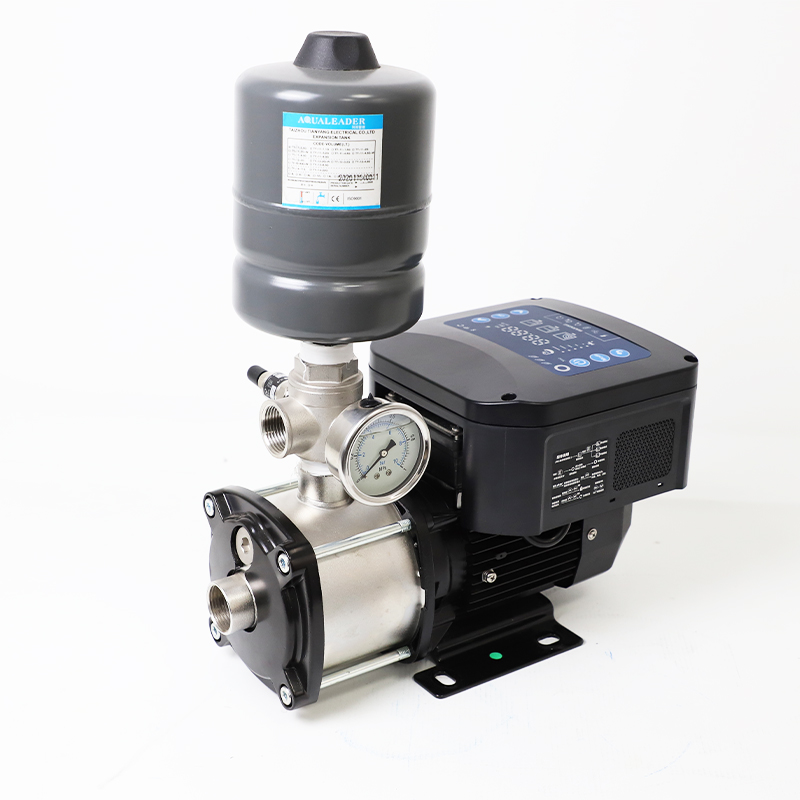
A variable frequency drive adjusts motor speed according to system demand. It is useful in constant-pressure systems where water consumption changes throughout the day.
A pressure sensor monitors discharge pressure and sends a signal to the controller. When demand rises, the VFD increases motor speed. When demand falls, it reduces speed.
This can provide smoother pressure and reduce repeated starting and stopping. It may also lower energy consumption when the pump spends significant time below maximum demand.
However, a VFD does not guarantee a fixed energy-saving percentage. Savings depend on the system curve, operating profile, pressure setpoint and static head. Systems operating close to full demand for most of the day may achieve less benefit.
The motor and VFD must be electrically compatible. The following conditions should be confirmed:
- Rated voltage and current
- Approved frequency range
- Motor insulation suitability
- Minimum continuous speed
- Cable length and installation method
- Overload and protection settings
At low speed, a standard fan-cooled motor receives less cooling because its fan is also rotating more slowly. The minimum continuous frequency should therefore be defined during system design.
A VFD does not automatically make a 50 Hz motor suitable for 60 Hz operation. Both the motor and pump must be approved for the intended maximum frequency, voltage, speed and power demand. Otherwise, the VFD output should be limited to the rated frequency.
For more information about variable-speed pressure control, see the MISLIER Constant Pressure Pump Guide.
Information required for motor selection
For accurate vertical pump motor selection, we need the required flow, total dynamic head, liquid type, liquid temperature and expected operating range.
We also need:
- Voltage
- Phase
- Frequency
- Ambient temperature
- Installation altitude
- Starting or control method
- Required pressure setpoint if a VFD is used
For a replacement project, clear photographs of the existing pump and motor nameplates are helpful. Mounting dimensions, motor frame, flange, shaft and coupling information may also be required.
Selecting a replacement only by kilowatt rating can result in the wrong frame size, shaft diameter, mounting flange or electrical connection.
MISLIER can support pump and motor matching, performance selection, system design, OEM/ODM configurations and installation guidance.
Not sure which motor specification to choose?
Send us the pump duty point and local voltage, phase and frequency. We can match the pump curve, motor power and control method for your project.
Frequently Asked Questions
What is the normal speed of a two-pole vertical pump motor?
The synchronous speed is 3,000 rpm at 50 Hz and 3,600 rpm at 60 Hz. The actual rated speed of an induction motor is slightly lower because of slip and must be checked on the nameplate.
Does a 60 Hz pump always produce more pressure than a 50 Hz pump?
If the same pump runs at a higher speed, it will generally produce more flow and head. However, the actual operating pressure depends on the pump curve and system curve. The 60 Hz performance data should be checked.
Can I install a larger motor to obtain more pump flow?
No. A larger motor does not make a fixed-speed pump rotate faster. It only provides more available power. Flow and head depend mainly on the pump hydraulics, rotational speed and system operating point.
Can a 50 Hz motor run on a 60 Hz power supply?
Only when the motor nameplate and manufacturer’s data approve the intended 60 Hz voltage, speed and load. The pump’s 60 Hz curve, shaft power, NPSH and maximum working pressure must also be checked.
Can a VFD convert any 50 Hz pump into a 60 Hz pump?
No. A VFD can change its output frequency, but it does not automatically approve the motor or pump for higher-speed operation. If the equipment is not rated for 60 Hz, the VFD output should remain within the approved frequency range.